

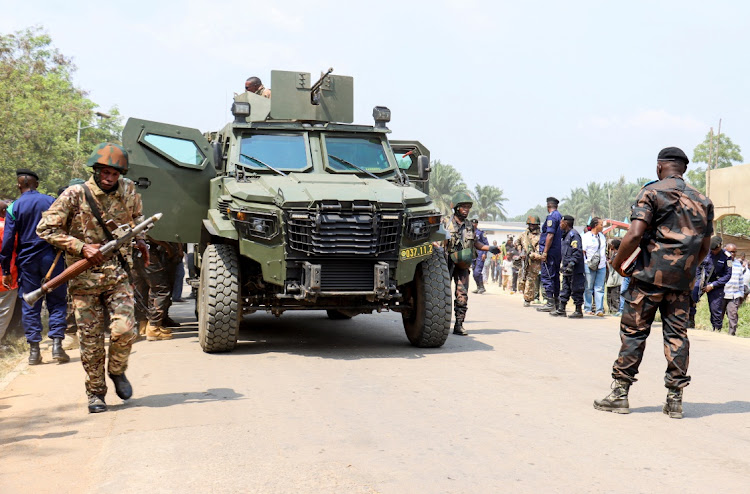
The war in eastern DRC is no longer a local insurgency—it has morphed into a regional power struggle where multiple actors are repositioning themselves for post-conflict strategic advantage. The deployment of the Uganda People’s Defence Forces (UPDF) may not be an outright declaration of hostility against the March 23 Movement (M23), but make no mistake: their presence is dangerous.
The UPDF’s official justification—neutralizing the remnants of the Allied Democratic Forces (ADF)—is a tactical smokescreen. The ADF, despite its history of unspeakable brutality, is at its weakest. Uganda has, on multiple occasions, claimed it has dismantled the terrorist group. So why the sudden reinforcement of troops? The answer is not in Uganda’s rhetoric but in its strategic calculations.
This war is not just about the battlefield—it is a contest of positioning, influence, and economic dominance. Uganda, along with other regional players like South Africa, Burundi, Tanzania, and now Chad, are not neutral observers; they are active participants maneuvering for control of the Great Lakes region.
In 2013, a senior FARDC officer who had just fled the battlefield in Rutshuru was overheard in Goma saying, “Fighting these men is like fighting ghosts. We move in to attack, they vanish. We dig in to defend, they are suddenly in our rear.” His despair was understandable. M23 operates with precision, cohesion, and a clear strategic vision. Unlike Kinshasa’s demoralized army, this is a force built on survival and necessity. But the current regional dynamics complicate everything.
Uganda’s military doctrine, honed over decades of counterinsurgency operations, emphasizes forward deployment, preemptive positioning, and strategic alliances. Their current presence in North Kivu—though not directly engaging M23—is an encirclement strategy. If the tides of war were to shift and M23 needed to reposition northward, the UPDF’s presence would create a natural blockade. This is not a coincidence. Uganda is making it clear that M23 will have no northern escape corridor.
Moreover, this deployment signals to Kinshasa that Uganda remains a key power broker. President Yoweri Museveni’s government is not willing to bet everything on one side. By maintaining a military footprint in eastern DRC, Uganda ensures that any future power shift will require Kampala’s involvement—either as a mediator, a gatekeeper, or a spoiler.
However, while this analysis is based on historical and geographical factors, a senior general in Kigali shared a different perspective. According to him, Rwanda highly doubts that Uganda’s deployment carries a confrontational intent. Instead, it would be considered “a backup on the left front.”
This assessment introduces an alternative reading of Uganda’s positioning—one that suggests a layered strategy rather than outright hostility. From a purely military standpoint, Uganda’s presence could serve as a buffer against a wider regional escalation, ensuring that spillover violence does not reach its borders. If true, this would mean Uganda is hedging its bets—neither openly siding with Kinshasa nor committing fully to M23.
However, even if Uganda’s deployment is not overtly confrontational, its mere presence complicates the battlefield. It creates an additional variable that M23 must factor into its strategic calculations. The question remains: if Uganda is truly aligned with M23, why not deploy alongside M23 and openly support its cause? Why the ambiguity?
Let’s not deceive ourselves. If Uganda were truly on the side of M23, it would deploy alongside M23, not in a way that restricts its movement. If Museveni and his generals genuinely wanted to save their own people from being butchered, they would take decisive military action in support of M23 instead of engaging in diplomatic ambiguity. Why the hesitation? Evil is evil. Uganda shouldn’t shy away from openly helping M23 militarily. Deploying separately under the pretext of countering the ADF while M23 fighters risk everything on the battlefield is, at best, a strategic miscalculation and, at worst, a betrayal. The reality is harsh: M23 fighters and the people they protect might perish in the eyes of the world, and no one will save them. That is the truth.
Beyond military strategy, Uganda’s intervention has economic implications. The war economy of eastern DRC has long been a source of wealth for external actors, and the UPDF’s deployment is as much about securing economic corridors as it is about security. Already, Ugandan transactions in eastern DRC are conducted in Ugandan shillings. This is economic expansion disguised as military cooperation.
For Uganda, maintaining control over trade routes, border crossings, and mineral-rich territories is a strategic necessity. By stationing troops in the region, Uganda creates an economic buffer zone that guarantees its continued influence—regardless of who wins the war. South Africa is also playing the long game, using its military presence to cement economic interests. There is nothing altruistic about Pretoria’s involvement—it is about securing lucrative mining contracts and controlling critical trade routes. This is why South Africa is backing Kinshasa so aggressively.
The M23 movement is not just another rebel faction; it is a battle-hardened force that understands the political and military landscape of eastern Congo better than any other actor. Unlike Kinshasa’s demoralized FARDC, M23 fights because it must, and its fighters know that defeat is not an option. But the presence of multiple regional forces complicates its operational freedom. Burundi’s military presence south of Goma, South Africa’s troop deployments under the SADC mission, and now Chad’s unexpected intervention create an increasingly congested battlespace. These forces, while officially part of “peacekeeping” missions, are ultimately serving the interests of their respective governments.
Burundi has historical tensions with Rwanda and will always align its military positioning accordingly. South Africa seeks to maintain its influence in the region, using the DRC as a proxy battlefield to assert its dominance within the SADC bloc. Tanzania, with its longstanding ties to Kinshasa, is unlikely to remain passive. Chad’s involvement is perhaps the most telling—an indication that Kinshasa is desperate enough to seek reinforcements from anywhere, even a country that has no historical stake in the region.
This is where Rwanda stands apart. Unlike Uganda, South Africa, or the others, Rwanda is the only country that has openly acknowledged the reality of the conflict. Rwanda understands that what M23 is fighting against directly threatens its own survival. There is no hypocrisy, no diplomatic ambiguity—Rwanda knows that Kinshasa’s chaos and hostility pose an existential danger, and Kigali has never shied away from saying so. That is why M23’s struggle is as much about securing eastern Congo as it is about ensuring Rwanda’s long-term stability.
M23 must acknowledge that it is fighting not just the FARDC, but a coordinated, multi-front intervention by regional actors. The Congolese government itself is merely a pawn in a larger strategic game where foreign militaries are using the conflict to establish long-term influence. However, history remains on M23’s side. Kinshasa has never won a war—its forces are ill-trained, poorly motivated, and fundamentally incapable of securing eastern DRC. M23’s operational superiority remains undisputed, but its challenge now is to navigate the regional geopolitics.
At the heart of this war is not just military engagements but the question of blocking M23’s options for maneuver and drawing the line for a possible exit. Uganda’s positioning effectively constrains M23’s ability to expand northward or reposition itself tactically. Whether this is a deliberate strategy or a consequence of Kampala’s broader regional ambitions, it adds a new dimension to the war. M23 is not just facing enemies in Kinshasa but a region increasingly entangled in strategic realignments.
This war is no longer just about M23, the Congolese government, or even the question of eastern DRC’s autonomy. It is about the realignment of power in the Great Lakes region. Uganda’s deployment, South Africa’s involvement, Burundi’s positioning, and Chad’s unexpected appearance are all symptoms of a deeper struggle for control.
Last week on one evening, a Congolese intelligence officer in Bukavu admitted to our investigative journalist that, “We have no real government, no real army. Only deals. We make deals to survive.” That reality has not changed. If anything, it has become more apparent.
M23’s success is inevitable—but what comes after victory will be just as critical as the war itself. The real question is: who will control the spoils of war? And more importantly, who will write the next chapter of eastern DRC’s history? This war is not just about what is happening now. It is about what happens next.