

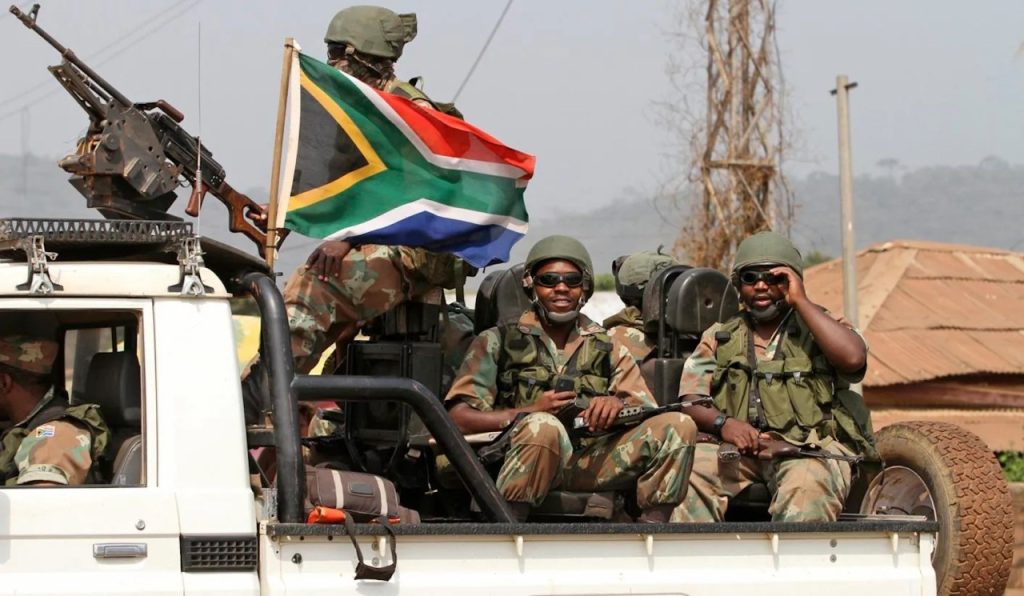
South African and Burundian troops, recently defeated in battle by the M23 rebel movement in Goma, face allegations of attempting to smuggle significant amounts of gold from their barracks. The accusations come amid reports that European mercenaries captured by M23 were also found with gold, raising further concerns over illicit activities linked to the ongoing conflict in eastern Democratic Republic of Congo (DRC).
While the South African National Defence Force (SANDF) has come under scrutiny for allegedly stashing gold in their barracks, Burundian troops have been accused of playing a leading role in the massacres carried out on behalf of Congolese President Félix Tshisekedi’s government. Despite receiving meager pay, Burundian forces have remained at the forefront of the conflict, fighting alongside the Congolese army (FARDC) and other allied militias in their bid to defeat M23.
Following their battlefield losses, South African troops reportedly requested the reopening of Goma Airport to facilitate their departure. M23, which now controls the area, refused and instead suggested that SANDF personnel exit via Rwanda, similar to how detained European mercenaries were previously repatriated. When South Africans then sought to leave under the protection of United Nations (UN) vehicles belonging to MONUSCO, M23 rejected the request, stating that all departing forces must be searched.
M23’s capture of Goma has further exposed the vulnerabilities of the coalition forces fighting against the rebels under a UN-sanctioned Chapter Seven mandate. This alliance includes MONUSCO, FARDC, the Southern African Development Community (SADC) regional force, Burundian troops, remnants of the Rwandan FDLR militia, and various local armed groups. Despite their numerical advantage, these forces were unable to hold Goma against M23’s offensive.
During the takeover, M23 reportedly seized heavy artillery abandoned by retreating forces. While the group has since returned MONUSCO’s vehicles, it has imposed restrictions on their movement to prevent the smuggling of gold and other valuables. Reports indicate that UN troops were unable to evacuate their last shipment of gold before Goma fell.
Meanwhile, the bodies of South African soldiers killed in combat have been repatriated through Rwanda, and Burundian forces continue to sustain heavy casualties in the conflict. Despite this, Burundi remains deeply engaged in the fighting, driven by Tshisekedi’s promises and financial incentives.
The UN and the international community have called on M23 to lay down its weapons and withdraw from the territories it now controls, but the group remains defiant. It continues to assert its claim over what it describes as its “liberated native land.” At the same time, uncertainty surrounds the fate of remaining foreign mercenaries in Kisangani, as M23 leaders reportedly view them as combatants unprotected by international law.
The situation in eastern DRC remains volatile, with military, political, and economic interests deeply entangled in the conflict. As M23 consolidates its position, allegations of resource exploitation by foreign forces further complicate the region’s fragile security landscape.