

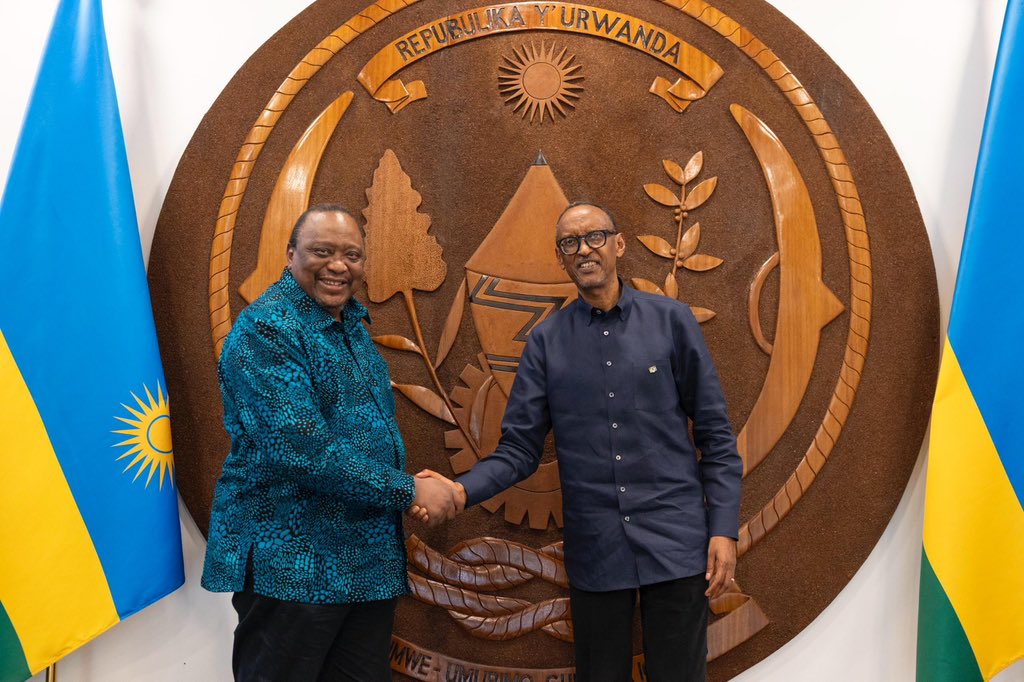
President Paul Kagame yesterday received former Kenyan President Uhuru Kenyatta at Urugwiro Village for a high-level meeting centered on the persistent conflict in eastern Democratic Republic of Congo (DRC).
Kenyatta, serving as one of the designated facilitators under the joint EAC-SADC peace framework, is working to bring key stakeholders to the table in search of lasting peace in the region.
The timing of the meeting was notable. It follows President Kagame’s recent public remarks in which he challenged the political legitimacy of DRC President Félix Tshisekedi, describing him as a leader who was “handed over power by Joseph Kabila.”
Kagame added that Uhuru Kenyatta was a witness to that transfer—a sharp reminder of how regional dynamics and historical backroom deals continue to influence the conflict in Congo today.
The elephant in the room was the M23 rebellion, a thorny issue both inherited and mishandled, according to Kagame.
The rebel group, which re-emerged during Tshisekedi’s presidency, has become a major actor in the eastern DRC crisis.
Rather than defeat it militarily, Kinshasa now finds itself across the table from the same group—negotiating a peace deal in Doha under the auspices of international mediation.
Kenyatta’s role is delicate. As a former head of state turned peace envoy, he is now facilitating talks that stem from a crisis in which he was an indirect witness to its political origins.
Kagame’s candid critique illustrates a broader frustration: that the regional and international community have for years danced around the core issues—governance failures, ethnic manipulation, and proxy militias—without tackling the real roots of instability.
While no official communique was released after the meeting, sources close to the presidency say the two leaders discussed the broader implications of the Doha negotiations between Kinshasa and M23, as well as the importance of a durable and honest peace that does not shy away from uncomfortable truths.
This visit also comes at a moment when Tshisekedi’s government faces increasing internal criticism for its failure to contain insecurity in eastern DRC, and for allowing vast parts of the region to remain under militia control.
From a diplomatic lens, the Kigali meeting reinforces Rwanda’s position that security solutions must be anchored in political clarity—not just military muscle or rhetorical appeasement.
As Doha talks continue and the region recalibrates its approach, the Kagame-Kenyatta meeting signals that silence is no longer an option.
Behind the handshakes and statements lies a deeper call for accountability—one that may determine the fate of peace in the Great Lakes region.