

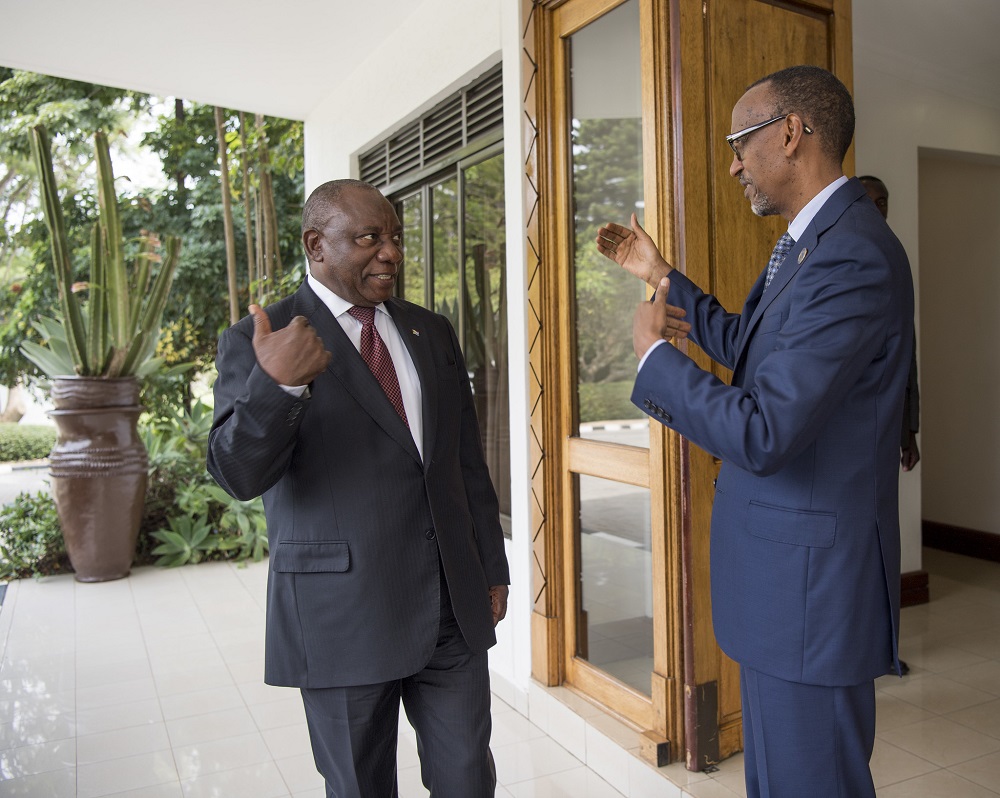
Relations between Rwanda and South Africa have long been tense, shaped by political mistrust, security rivalries, and competing regional interests.
While both countries are key players in Africa’s political and security landscape, mutual suspicion has defined their interactions for over a decade. Despite this hostility, Rwanda continues to show restraint and a willingness to normalize ties, even in the face of provocation.
The strained relationship dates back to the late 2000s when South Africa became a haven for members of the Rwanda National Congress (RNC), a group Kigali classifies as a terrorist organization.
The RNC was founded by former Rwandan military and intelligence officials, including General Kayumba Nyamwasa and Patrick Karegeya, both accused of plotting to destabilize Rwanda.
Karegeya’s mysterious assassination in Johannesburg in 2013 further deepened mistrust; South Africa accused Kigali of involvement, which Rwanda denied.
The fallout led to diplomatic expulsions and a freeze in engagement.
Tensions later grew as South Africa aligned with the Democratic Republic of Congo (DRC) through the Southern African Development Community (SADC) mission known as SAMIDRC.
South African troops supported the Congolese army (FARDC) in operations in eastern DRC; actions Kigali viewed as hostile and provocative. South Africa backed Congolese offensives near Rwandan defensive positions, reinforced Kigali’s perception that Pretoria had taken sides.
The involvement of South African forces left a diplomatic scar that reflected deeper regional divisions.
During the height of the fighting in eastern DRC, Kigali and Pretoria exchanged harsh words and accusations. South African officials claimed Rwanda was backing the M23 rebels; Rwanda dismissed the allegations and accused South Africa of fueling instability by supporting the Congolese army.
The tension escalated into an open diplomatic confrontation; both sides issued warnings and threats through the media. Presidents Paul Kagame and Cyril Ramaphosa also traded unfriendly remarks in public statements, reflecting the depth of mistrust between the two governments.
Yet, relations had already worsened when South Africa imposed strict visa restrictions on Rwandan nationals, effectively halting normal travel between the two countries.
Only official and service visa holders are now allowed entry. Kigali regarded this as deliberate diplomatic hostility that undermined economic and people-to-people exchanges.
Analysts argue that the decision weakened the African Union’s vision of continental integration and cooperation.
Despite repeated provocations, Rwanda has avoided retaliation; instead, it has chosen cooperation and diplomacy. When SAMIDRC soldiers captured by M23 rebels sought a safe exit, Rwanda facilitated their passage and ensured their safety; a gesture widely seen as one of maturity and professionalism.
More recently, Rwanda’s Interpol handed over stolen vehicles from South Africa that were intercepted by the Rwanda Investigation Bureau (RIB); an act reflecting commitment to international law enforcement cooperation despite political tension.
These gestures highlight a clear contrast; while South Africa’s posture toward Rwanda remains confrontational, Kigali continues to value regional harmony over grudges. By offering safe passage to South African soldiers and returning stolen property, Rwanda has demonstrated that responsible state behaviour and principled diplomacy are more effective than hostility.
The relationship between Kigali and Pretoria remains one of mutual mistrust, shaped by security concerns, political allegiances, and historical grievances. Yet the path toward normalization remains open if South Africa chooses honest dialogue and renewed engagement.
Both nations stand to gain from restored cooperation in trade, security, and regional integration.
A rare sign of thawing relations came when Presidents Kagame and Ramaphosa met in Brussels on the sidelines of the European Union–African Union summit.
After months of public hostility, the two leaders exchanged friendly gestures and engaged in a warm conversation, signaling a possible shift toward reconciliation.
The encounter suggested that despite years of tension, dialogue and diplomacy remain the only viable path forward for Rwanda and South Africa.