

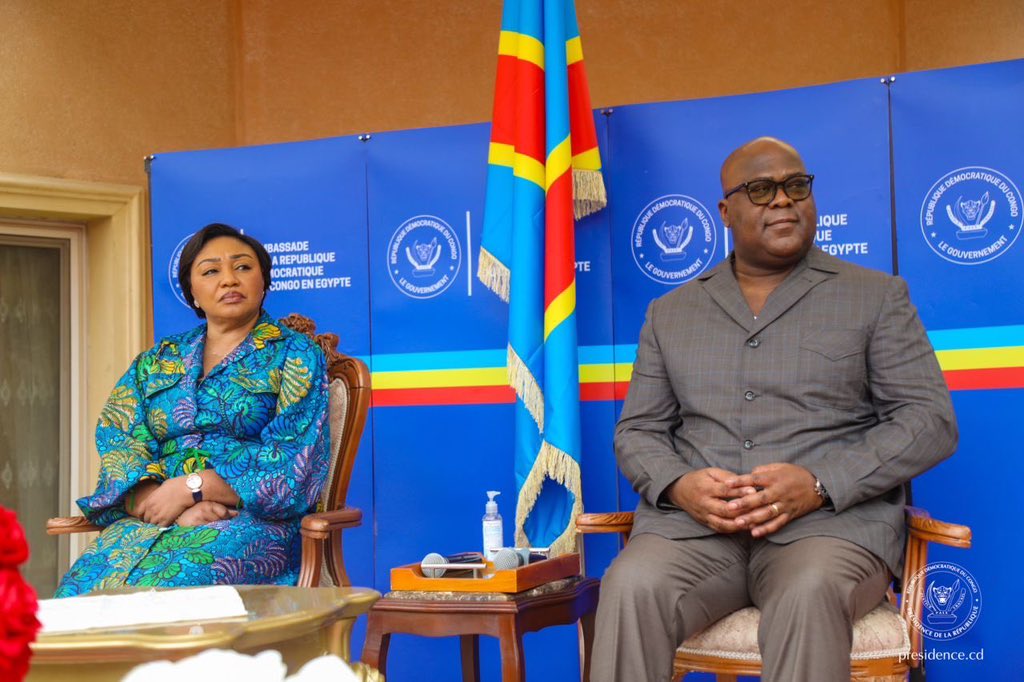
President Félix Tshisekedi has once again left observers puzzled after announcing that discussions between his government and the Alliance Fleuve Congo (AFC/M23) will resume next week, a sharp reversal from his earlier declarations that he would never negotiate with terrorists.
The Congolese leader, speaking during his visit to Egypt, appeared to contradict his previous stance by confirming that formal talks with the AFC/M23 are imminent.
“Talks between the AFC/M23 and my government will resume next week,” Tshisekedi said. “It is only after that that Washington, which is awaiting the conclusion of this agreement, will summon the Rwandan President and myself so that we can sit down with President Donald Trump to finally ratify the two agreements: Doha and Washington.”
His latest statement has sparked confusion among political analysts and the Congolese public, who accuse him of shifting goalposts and using peace negotiations as a communication tactic rather than a consistent strategy.
Tshisekedi’s mention of a potential meeting in Washington involving Rwandan President Paul Kagame, Donald Trump, and himself adds another layer of intrigue to the already complex diplomatic process surrounding the eastern Congo conflict.
The Doha agreement, facilitated by Qatar earlier this year, established a ceasefire framework and international monitoring mechanism.
The proposed Washington accord is expected to formalize broader political and security guarantees between Kinshasa, Kigali, and the AFC/M23.
While Tshisekedi’s latest remarks suggest renewed international engagement, critics argue that his frequent contradictions have undermined both his credibility and the coherence of Congo’s peace policy.
The AFC/M23 leadership has not yet officially responded to the announcement.
For many in Goma and beyond, the president’s changing tone once again raises questions over whether Kinshasa is pursuing genuine dialogue or simply buying time amid mounting political and military pressure.