

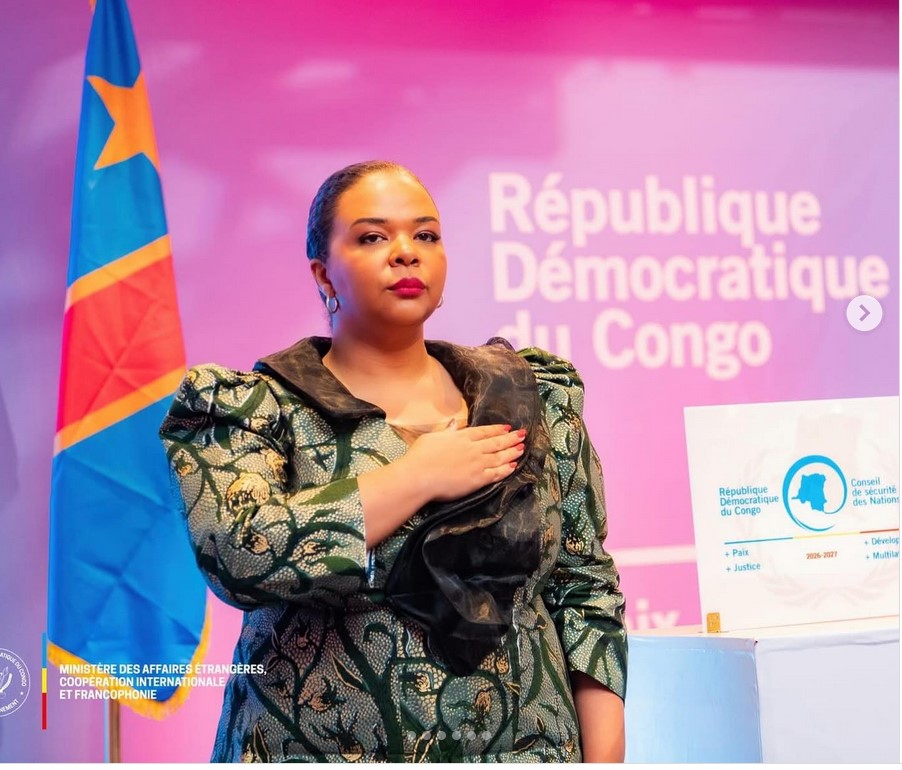
DR Congo’s Foreign Minister, Wagner Kayikwamba, finds herself at the intersection of personal ordeal and national politics. Her confirmed pregnancy has become the subject of widespread gossip, online mockery, and political speculation.
At the same time, she leads Kinshasa’s most aggressive diplomatic campaign in years against Rwanda and the M23 rebellion.
In Congo’s highly politicized environment, personal matters are often fused with public policy. What should have been a private milestone has been weaponised and transformed into a tool of ridicule, revealing deep-seated gender biases and the fragility of the political conversation in Kinshasa.
For more than a year, Kayikwamba has been the public face of Congo’s foreign policy offensive, accusing Rwanda of directly supporting the M23 insurgency.
Her fiery addresses at the United Nations and African Union conferences have amplified Kinshasa’s message of external aggression and national sovereignty.
Yet several of her claims have been challenged by independent monitors and humanitarian agencies, which found some of the cited incidents unverified or wrongly attributed.
This inconsistency has gradually eroded Kinshasa’s diplomatic credibility at a time when it most needs international trust.
Observers argue that the minister’s ordeal is symptomatic of a larger dysfunction — the government’s struggle to reconcile domestic pressure, wartime rhetoric, and global demands for factual accuracy.
With elections looming and the military losing ground in the east, officials have leaned heavily on emotional and nationalistic narratives to conceal operational failures.
But the attacks on Kayikwamba’s personal life have revealed the darker side of Congo’s public discourse. What began as political criticism quickly descended into mockery of her reproductive health — a deeply misogynistic form of attack that many say demeans not only the individual but the nation’s political culture.
Interestingly, the strongest campaign against this ridicule has not come from Kinshasa but from across the border in Rwanda. Rwandan commentators, activists, and diplomats have publicly condemned the mockery, many saying, “let’s leave that behind.”
In Rwanda, where public discourse is shaped by a deep sense of national dignity and respect for women, many have argued that such ridicule weakens the region’s moral fabric and undermines the serious diplomatic work required to resolve the crisis.
“Mocking a woman’s reproductive health will never strengthen our fight for survival,” one Rwandan observer noted. “It only lowers us to a petty level. We can do better.” The campaign has resonated widely among Rwandans who see dignity, restraint, and respect as essential components of their national and diplomatic identity.
For many, Kayikwamba’s experience exposes the persistence of patriarchal reflexes that punish women in power. Her pregnancy — a moment that should symbolize life and continuity — has been twisted into a political liability, fueling speculation about her capacity and focus. “When men raise their voice, it’s patriotism; when women do it, it’s hysteria,” one Congolese activist lamented.
Kayikwamba’s mixed Congolese–European heritage has also been cynically exploited. In a government that constantly warns of “foreign interference,” critics have used her background to question her authenticity, further entangling the personal with the political.
Within the foreign ministry, aides describe a demanding schedule of regional summits, crisis meetings, and nonstop media engagements. Despite relentless pressure and digital abuse, Kayikwamba remains visibly committed to her duties. Yet those close to her admit the personal toll has been immense.
Beyond the individual drama, Kinshasa faces a more serious challenge — a loss of credibility. Each time official statements are contradicted by UN or NGO findings, the government’s narrative weakens further abroad. Diplomats in Addis Ababa and Brussels privately say the DRC’s communication strategy has become increasingly reactive and emotion-driven, rather than grounded in verifiable evidence.
Ultimately, the controversy surrounding Wagner Kayikwamba has become more than a story about gender or diplomacy — it is a reflection of how personal vendettas and political insecurity distort public life.
It also highlights a regional contrast: while Kinshasa’s discourse grows coarser, Rwanda’s measured response reaffirms the strength of its values and diplomatic maturity.
As the noise fades, the lesson remains clear: leadership must rise above mockery and emotional distraction.
For Congo, that means restoring discipline and truth in its diplomacy. For Rwanda, it is a reminder that dignity — not derision — remains the highest form of strength.