

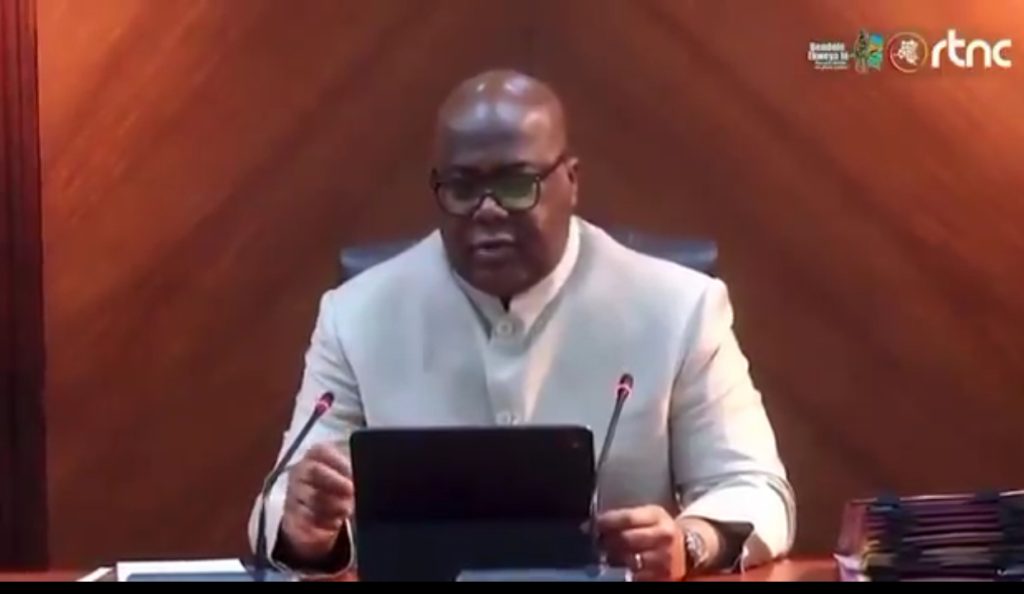
DR Congo President, Félix Tshisekedi, has condemned remarks by Major General Sylvain Ekenge, describing them as incompatible with republican values and national cohesion, a move widely viewed as prompted by international pressure following sharp condemnation of the language used.
During a cabinet meeting held on Friday, January 2, 2026, Tshisekedi disapproved of statements made by Ekenge, then spokesperson of the Armed Forces of the DRC (FARDC), and welcomed disciplinary measures taken against him, including his suspension.
The president also ordered the immediate establishment of a coordinated public communication strategy across government institutions to prevent further deviations and preserve national unity in a sensitive security context.
The controversy centers on the nature of Ekenge’s remarks, which observers say employed inflammatory and dehumanizing language closely resembling rhetoric historically used to incite mass violence.
Analysts and human rights observers have drawn explicit parallels to the propaganda and hate speech that helped instigate the 1994 Genocide against the Tutsi in Rwanda, where state-backed narratives framed entire groups as existential threats and legitimate targets.
It was this comparison, in particular, that triggered strong international reaction. Diplomatic partners and rights organizations warned that such rhetoric, when voiced by senior military officials, carries grave historical implications and risks fueling large-scale violence.
Critics argue that without this international outcry, the statements might not have been publicly condemned or sanctioned.
The episode has also exposed a deeper contradiction within Tshisekedi’s leadership. While the president now presents himself as a defender of republican values and national cohesion, similar ethnicized and militarized rhetoric has circulated for years within government circles and pro-state communication, especially in the context of the conflict in eastern Congo.
Ekenge’s language is therefore widely seen not as an isolated lapse, but as a reflection of a political environment long tolerated, and at times encouraged, by the state.
Observers warn that unless the Congolese leadership confronts this pattern decisively and consistently, disciplinary action taken under international scrutiny risks appearing reactive and symbolic.
Without a clear break from dangerous historical narratives, calls for unity may continue to ring hollow, particularly in a region where the consequences of such rhetoric are tragically well known.