

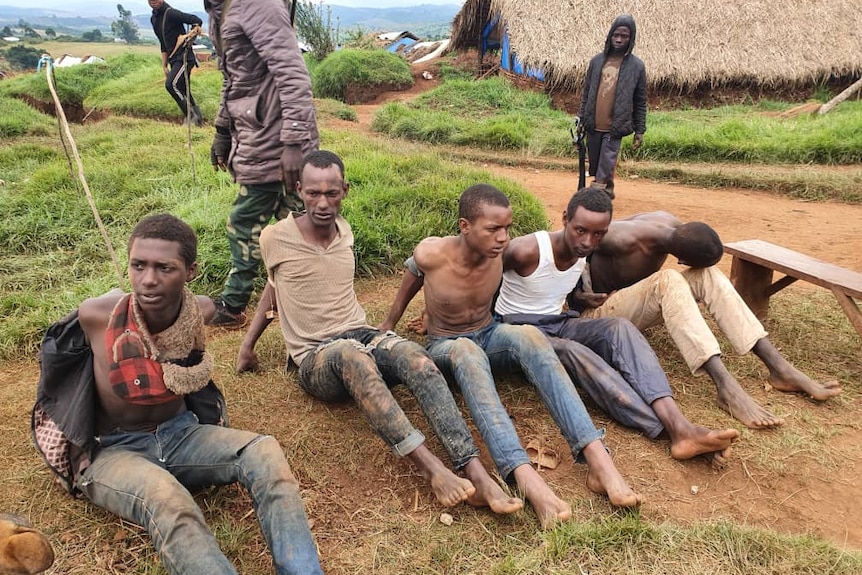
They burned the villages. They slaughtered the cattle. They killed the sons who had joined the army, and dismembered them in public squares.
For the Banyamulenge—an indigenous Tutsi community native to the highlands of South Kivu in eastern Congo—this is not a distant memory. It is their daily reality.
On May 3, 2025, the Banyamulenge diaspora, through a coalition known as GAKONDO, issued an urgent letter to world leaders, including officials in the United States and European Union.
In it, they pleaded for intervention to stop what they described as a slow, coordinated genocide that has unfolded in near silence.
The letter recounts years of atrocities, forced displacement, and a growing campaign of disinformation that threatens to bury the truth of their suffering.
Since 2017, more than 450 villages belonging to the Banyamulenge have been destroyed. Over 500,000 head of cattle—the backbone of the community’s economy—have been looted.
Families have been torn apart, and entire communities pushed into makeshift camps. Hundreds have been killed. The letter tells of a woman in Minembwe who watched her husband executed before her eyes.
With two small children in tow, she fled on foot, arriving days later at a displacement camp in Uvira, where she now survives on sporadic food aid and hope.
Two incidents stand out as especially harrowing. On December 9, 2021, Major Joseph Kaminzobe, a Banyamulenge officer in the Congolese army, was lynched and burned in Lweba, Fizi.
No one has been held accountable. Then on November 9, 2023, Lieutenant Gisore Kabongo Patrick was stoned and dismembered in public in Goma—his body parts reportedly consumed by the mob.
Videos of the attack circulated online for days before being removed.
But GAKONDO’s warning extends beyond the killings. They accuse former community leaders of aiding a disinformation campaign that denies the reality of the violence.
Enock Ruberangabo Sebineza, Jean Scohier Muhamiriza, and others are named in the letter as individuals who once walked away from peace negotiations in Nairobi, but now accompany Congolese officials abroad to dismiss the crisis as exaggerated or fabricated.
In January 2025, one of them, in a European meeting, reportedly claimed the genocide narrative was a “political ploy.”
To the Banyamulenge, this is betrayal. To GAKONDO, it is part of a calculated strategy to erase the community’s pain from the international record.
The letter also warns that this campaign of destruction is not just driven by ethnic hatred, but by the scramble for Congo’s mineral wealth.
In South Kivu and beyond, armed groups, economic interests, and state-backed forces are all vying for control—and the Banyamulenge are caught in the crossfire.
GAKONDO urges world powers not to trade lives for lithium and cobalt.
They are calling for independent investigations, international accountability for war crimes, and immediate protection of civilians.
They ask for global condemnation of denialism and direct engagement with legitimate Banyamulenge voices—not those aligned with the state narrative.
Signed by community leaders across North America, Europe, Australia, and East Africa, the letter is more than an appeal.
It is a warning. History, they say, is repeating itself. And the world, once again, may be too slow to respond.
In the highlands of South Kivu, people continue to run, to hide, and to bury their dead in silence. But through GAKONDO’s words, they have found a way to be heard—if the world chooses to listen.