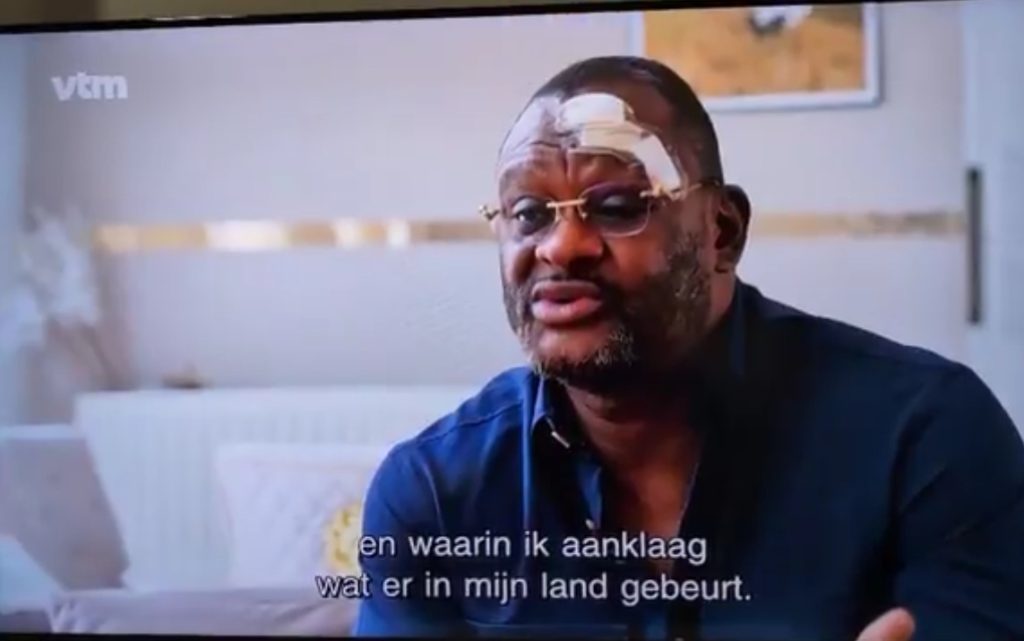
Brussels – Congolese journalist and political commentator Claude Pero Luwara has reportedly survived an assassination attempt in Belgium, in what analysts describe as a reckless expansion of the Democratic Republic of Congo’s repression machinery beyond its borders.
The incident has not only alarmed the Congolese diaspora but also fueled accusations that President Félix Tshisekedi is presiding over a state that increasingly behaves like a mafia syndicate.
Luwara, the director of CPLTV, a YouTube-based outlet with tens of thousands of followers, is notorious for his fiery critiques of Tshisekedi’s rule and his relentless chronicles of what he calls Congo’s “captured state.”
His broadcasts, often polemical and confrontational, have long divided opinion—garnering admiration among the opposition but provoking outrage in Kinshasa.
On August 28, 2025, Belgian police intercepted a group of armed men who had abandoned their vehicle after a botched operation. Opposition figures claim the men were an assassination squad dispatched to eliminate Luwara.
Several suspects were arrested, while others fled. Belgian authorities have not commented extensively, but the arrests point to what one analyst called a “brazen miscalculation,” exposing a clandestine network that has until now operated in the shadows.
Hours after the incident, Luwara released an audio message that was part defiance, part warning. “I’m doing very, very, very well… The fight will continue,” he said, insisting that survival was proof of resilience and a reminder that the struggle for Congo’s liberation will not be silenced by fear.
This was not the first time Luwara’s name was tied to political turmoil. In 2022, the Kinshasa-Gombe Court of Appeal issued a warrant for his arrest after he insulted Hydrocarbons Minister Didier Budimbu. Forced into hiding, he fled through Zambia before resurfacing in Europe.
By 2024, his troubles deepened when authorities accused him of aligning with the Alliance Fleuve Congo (AFC), a politico-military coalition linked to the M23 rebellion in eastern Congo.
Justice Minister Constant Mutamba seized two of his Kinshasa houses, alleging rebel financing, while a staggering US$4 million bounty was placed on his head.
For Tshisekedi’s critics, the Brussels episode confirms what they have long feared: Congo is no longer governed under the rules of democracy but under what dissidents call “ngelecracy”—a bastardized system where political violence replaces dialogue, and exile offers no safety.
Franck Diongo, an opposition leader, bluntly labeled the president a “global criminal,” accusing him of exporting repression across continents through hired assassins on state payroll.
Analysts note that the hunt for Luwara fits a broader pattern. Most of the government’s exiled targets are believed to have ties, real or alleged, to the AFC/M23 camp.
By branding them enemies of the state, Tshisekedi’s regime has effectively authorized a permanent manhunt.
Opposition voices claim a shadow unit—composed of operatives linked to military intelligence DEMIAP and the National Intelligence Agency (ANR)—is now prowling the globe, tasked with eliminating dissenters.
Yet, there is irony in the failed Brussels plot. A machine built on secrecy stumbled in the heart of Europe, its operatives exposed after a single misstep. What was intended to be a swift, quiet elimination has instead become a diplomatic embarrassment, with Belgium now under pressure to explain how Congolese political violence spilled into its streets.
Meanwhile, the Congolese government has remained silent, refusing to comment or respond to mounting queries. That silence, opponents argue, speaks volumes.
Luwara today stands as both fugitive and symbol—hunted by the state, embraced by some as a voice of resistance, denounced by others as a reckless provocateur whose ties to armed rebels complicate his claim to journalism.
His story is a microcosm of Congo’s grim political climate: a regime increasingly defined not by the ballot box but by hit lists, bounty notices, and now, failed assassination squads abroad.
The Brussels affair may mark a turning point. What was once whispered in exile cafés and opposition networks—that Tshisekedi’s Congo has become a mafia state with global reach—is now laid bare.
For some, it signals the birth of a rogue presidency that mistakes assassination squads for governance. For others, it is a reminder that in Congo’s long battle between authoritarianism and free expression, even survival is a form of resistance.