

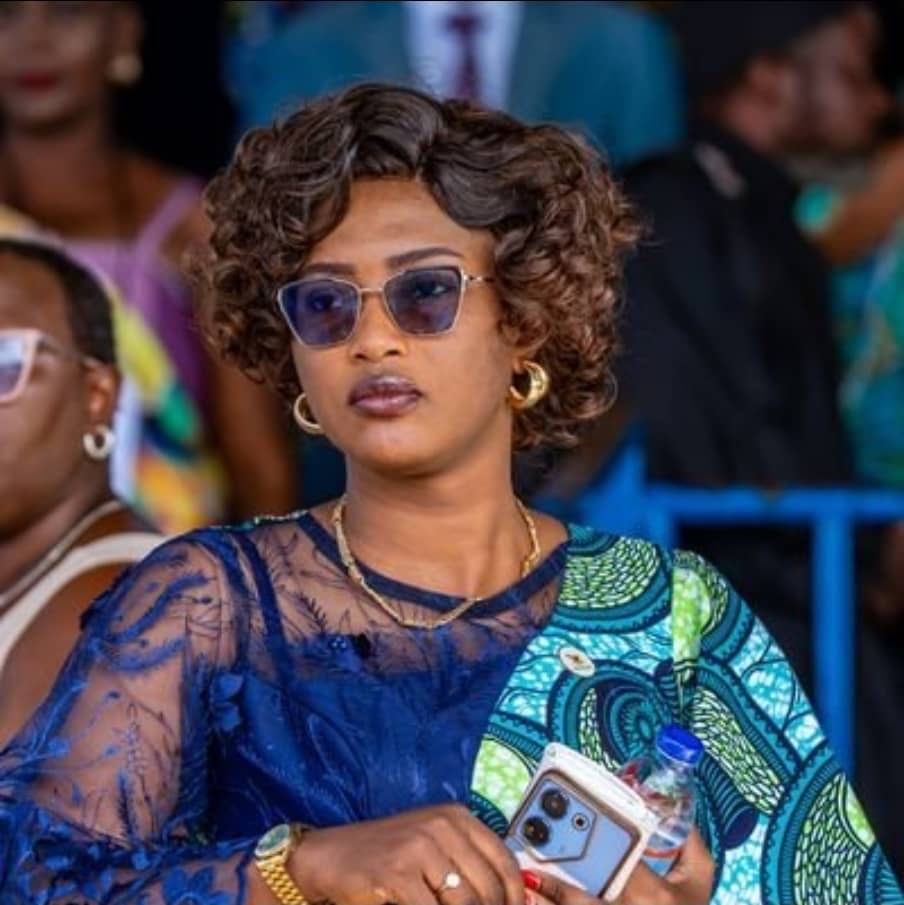
In a country where speaking out against the government can cost you your freedom or your life, Brenda Monkango Nganga has chosen courage over silence.
A native of the Équateur Provincial Territory and long-time resident of Kinshasa, Brenda’s life has been shaped by both her community roots and the relentless weight of political persecution.
Her troubles began not only because of her activism, but also because of her appearance. In Kinshasa, she was harassed and threatened simply for resembling Tutsis, with some taunting her to “go back to Rwanda.”
To Brenda, these attacks revealed something deeper: a system where prejudice, politics, and fear are weaponized against those who dare to stand apart.
“I was not targeted just for my ideas, but for who they claimed I looked like. It showed me that injustice in Congo is not only political—it’s personal, it’s ethnic, it’s systemic,” she recalls quietly.
Her path to activism began in the halls of the Institut Supérieur Pédagogique (ISP) in La Gombe, where she first became known as a fearless student president.
Later, she would climb the professional ladder as a Human Resource Manager with the insurance company, RAWSUR and later ran her own Tour Company in Congo Central. But those achievements were only a prelude to her more dangerous role: joining the Congo River Alliance (AFC/M23) in 2024, under the leadership of Corneille Nangaa.
Since then, Brenda has become more than a professional or organizer; she is a revolutionary figure. Her affiliation with AFC/M23 made her a target for President Félix Tshisekedi’s government.
In August 2024, she was sentenced to death in absentia, a ruling she calls “an attempt to erase dissent, not a judgment of justice.”
Despite the sentence, Brenda continues to work as a Personal Assistant and Chief of Protocol in Nangaa’s Office, where she is known for running operations with precision.
Colleagues describe her as the quiet engine of the movement, meticulously planning and executing complex tasks, from coordinating sensitive meetings to ensuring security protocols are followed without error.
Her discipline and organizational skill have allowed the office to function smoothly, even under pressure and constant threat.
Living in exile in eastern DRC, she remains a central figure in what she describes as the broader struggle to unravel Tshisekedi’s dictatorship. “The fight is not only for leaders or for soldiers. Even women like me, behind the scenes, are carrying their share of the burden,” she insists.
She is one of the thousands of other resilient and committed women, some in uniform behind enemy lines and others serving in positions of authority within the movement. They are the unsung heroines in the movement.
Friends say Brenda carries herself with a mix of steel and grace. She still leans on her Christian faith, the same force that sustained her during her days as a campus leader.
But her defiance has become the trait most people remember. A colleague recalls one incident in which she refused to cancel a sensitive meeting despite direct threats, calmly reorganizing security and pushing forward with the agenda as if nothing had happened.
To those around her, this ability to work under fire embodies the resilience the Congolese opposition needs to survive.
Her story is not just one of survival but of persistence. Against the weight of a state determined to silence her, Brenda, like many of her compatriots, continues to fight, proving that even in the shadows of exile, resistance can find its strongest voice.