

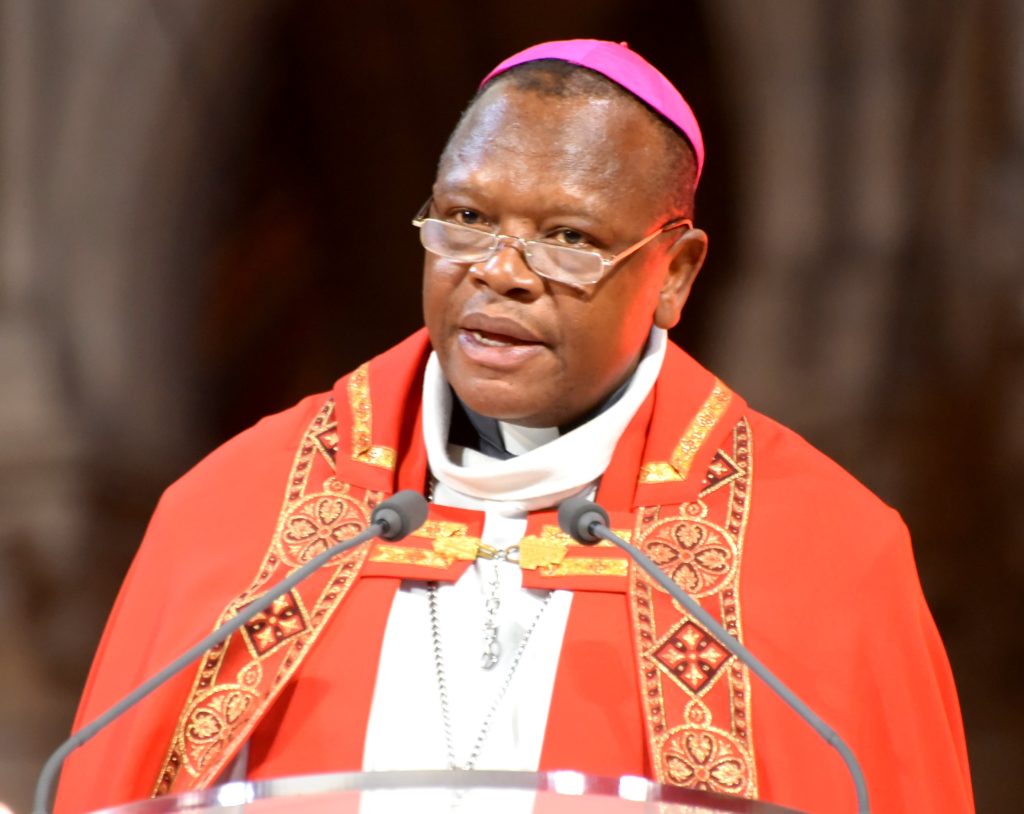
Cardinal Fridolin Ambongo has ignited controversy after fiercely rejecting the recent agreement between the Democratic Republic of Congo (DRC) and the United States, a deal brokered under American facilitation.
Referring to it dismissively as “la solution de Trump,” the influential Catholic leader questioned the legitimacy and effectiveness of foreign-driven approaches to Congo’s deepening crises.
“He tried that solution in Ukraine. It didn’t work,” Ambongo said in reference to Donald Trump’s foreign policy legacy. “But here, everyone runs, everyone fears Trump. We say with these documents: this is enough. Enough of false solutions. Enough of decisions made without listening.”
His remarks, made during a high-profile televised panel, were widely interpreted as an indictment of not only American interference but also of Kinshasa’s growing dependence on foreign mediation in internal affairs.
The cardinal’s words have since triggered a national firestorm—some defending his bold stance, others accusing him of recklessness at a fragile time for the nation.
The DRC is currently navigating turbulent waters.
The government has come under fire for failing to address persistent domestic crises—ranging from widespread insecurity, especially in the east, to governance failures, corruption, and chronic institutional dysfunction.
Entire regions remain under the grip of militias and rebel groups, with civilians bearing the brunt of the violence and government brutality.
Recent coup attempts have further exposed the fragility of the state.
While none succeeded, they’ve deepened fears of political instability and discontent within the military ranks.
Against this backdrop, critics argue that the US-brokered deal is more of a foreign patchwork than a sustainable solution—and that it risks inflaming tensions rather than resolving them.
While the details of the US-DRC agreement remain under wraps, it is believed to involve military cooperation, security sector reform, and intelligence coordination aimed at stabilizing volatile regions.
Supporters see it as a much-needed partnership in the face of rising threats. But detractors, like Cardinal Ambongo, say it repeats the mistakes of past externally imposed solutions that ignore local realities.
His comments, however, have not gone unchallenged.
Government supporters and some analysts have labelled them “irresponsible” and “ill-timed,” arguing that the clergy’s intervention risks fueling anti-government sentiment at a moment when unity and reform are desperately needed.
Still, many Congolese—exhausted by years of violence and broken promises—see in Ambongo’s words a reflection of their own frustrations.
His criticism has laid bare a critical divide: between those who still believe in sovereign, homegrown solutions, and those who see external partnerships as the only way forward in a country long caught between foreign interests and internal dysfunction.
With coup plots in the recent past, rebel advances in the east, and a population increasingly disillusioned, the DRC stands at a crossroads.
Whether the US partnership stabilizes or destabilizes the fragile equilibrium remains to be seen.
But one thing is certain—Cardinal Ambongo’s voice, controversial or not, has forced the country to confront difficult questions it can no longer avoid.