

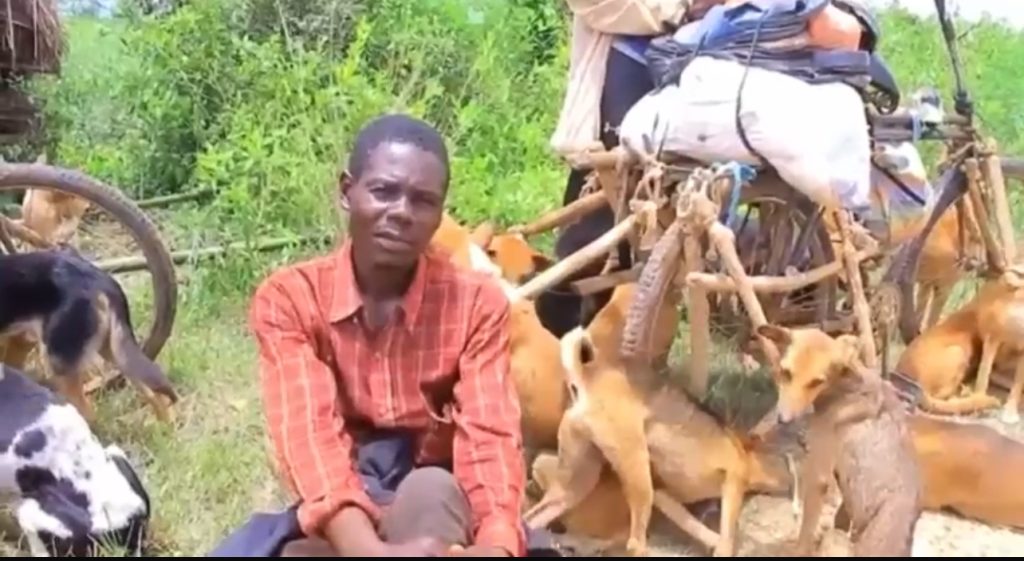
On a dusty road leading into Mbuji-Mayi, a trader pedals slowly, his old bicycle groaning under the weight of three dogs tied to the frame. The animals, their ribs visible and coats ragged, whimper softly as the wheels bump over potholes.
By the time the man enters the city, a small crowd gathers—children run alongside the bicycle, pointing and laughing, while older passersby exchange knowing glances. Everyone understands what the dogs represent. They are not guards or companions anymore. They are food, soon to be bargained for in the market.
At the marketplace, voices rise as buyers gather around. Some ask about the price, others poke at the animals’ thin frames, debating whether they will yield enough meat. A sale at 5,000 Congolese francs—less than two dollars—can set off fierce haggling, with buyers hoping to stretch their money and traders pushing back, eager to make a profit.
For many, this exchange is more than commerce; it is a fragile means of survival in a city where formal jobs are scarce and meals are never guaranteed.
For some, the aroma of the simmering stew that follows carries the taste of celebration and tradition. For others, it is a troubling sign of desperation. Inside those pots is dog meat—an increasingly sought-after delicacy that has become both a cultural marker and a survival strategy in a country struggling with poverty.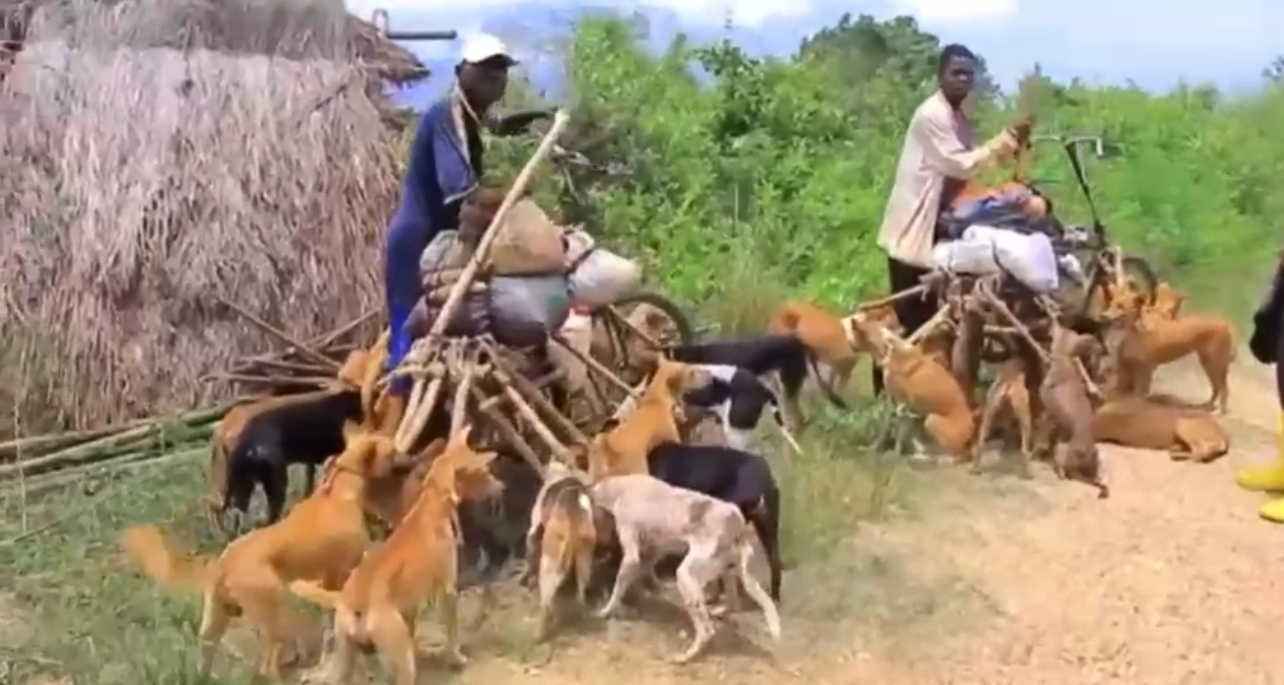
The trade begins hundreds of kilometers away in Maniema province, where small-scale traders collect African domestic hunting dogs at low cost before making the long journey to Kasai Oriental. By the time they reach Mbuji-Mayi, a single dog can mean days of meals for a family or the chance for a trader to pay school fees. “It’s not just business,” one Maniema trader explained. “It’s survival. Without this trade, I don’t know how I would provide for my children.”
Dog meat itself is not entirely new to Congolese cuisine, though in this region its rise is more recent. Across other provinces, families have long prized wild delicacies such as snakes, monkeys, and various reptiles. In Mbuji-Mayi, however, the turn to dog has given rise to new debates. For some households, it has become the centerpiece of festive meals, replacing goat or chicken. “We grew up eating wild animals,” recalled a miner who recently bought a dog for his son’s birthday feast. “Now, dog meat is what makes a celebration special here.”
That sense of tradition, however, clashes with modern discomfort. On social media, arguments flare between those defending the meat as cultural identity and others condemning it as a symptom of poverty and hunger. Animal welfare advocates worry about the lack of regulation and veterinary oversight. “There are no protections for the animals and no system to check the safety of the meat,” one activist warned. “This is happening in complete silence.”
To many Congolese, though, those concerns are distant. What matters most is putting food on the table. One young mother, buying a small portion in Mbuji-Mayi’s market, shrugged at the criticism: “When children are hungry, culture is not the problem. Hunger is the problem.”
Authorities have yet to comment on the trade, and no official steps have been taken to regulate it. In the meantime, the sight of skinny dogs strapped to bicycles, children chasing alongside, and the aroma of simmering pots in Mbuji-Mayi keep telling a story larger than food.
They speak of resilience, of the weight of tradition, and of the hard choices people make when survival is on the line.