

A failed coup attempt has rocked the Democratic Republic of Congo (DRC), exposing deep fractures within the country’s military and political elite.
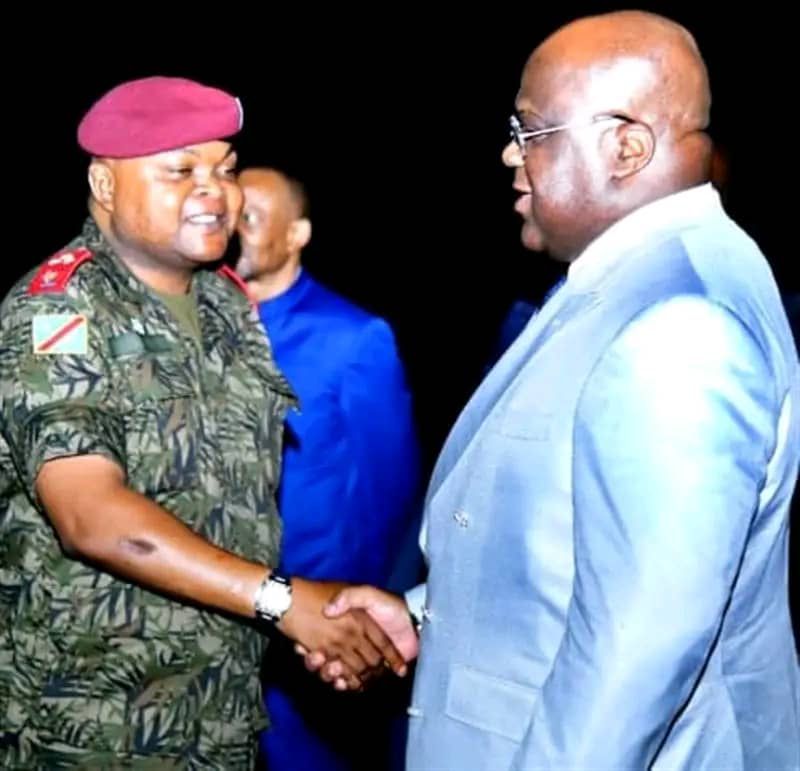
At the center of the unfolding crisis is General Christian Tshiwewe Songesha, a powerful and longtime confidant of President Félix Tshisekedi, who now finds himself under military lockdown and political scrutiny.
According to security sources, the tension erupted in the early hours of July 8 during a National Security Council (NSC) meeting, where General Tshiwewe engaged in a sharp confrontation with Lieutenant General Jean-Claude Yav at around 1 a.m.
The two reportedly exchanged accusations related to an alleged plot against the presidency.
While Yav was later released, Tshiwewe remained under surveillance, and his inner circle—including his former chief of staff Major General Maurice Nyembo and his secretary, Colonel Adelard—were swiftly detained.
By dawn, General Tshiwewe’s residence in Kinshasa had been surrounded by troops.
No one is allowed in or out, his security guards have been arrested, and even some members of his church have reportedly been taken into custody.
The DRC government has yet to issue an official statement on the matter, but widespread arrests are ongoing, signaling the gravity of the situation.
Tshiwewe, born in Lubumbashi and originally from Lualaba Province, is a seasoned and decorated officer in the Armed Forces of the DRC (FARDC).
He rose through the ranks of the Republican Guard—an elite unit tasked with protecting the head of state—and eventually became Chief of Staff of the FARDC in 2022.
Though removed from that post in December 2024 amid growing security challenges in eastern Congo, Tshiwewe was appointed military adviser to President Tshisekedi, a move that maintained his proximity to power.
The current turmoil evokes painful echoes of Congo’s troubled political past. Since independence, the DRC has seen a succession of violent transitions, assassinations, and military power plays.
Patrice Lumumba, the country’s first Prime Minister, was brutally murdered in 1961 with the complicity of foreign powers. President Laurent-Désiré Kabila was assassinated by a member of his own security team.
Even Mobutu Sese Seko, who ruled the country for over three decades with an iron grip, was ousted by military force in 1997 after a long decline marked by internal decay and rebellion.
Mobutu’s reign left a deep imprint on Congo’s political DNA—centralized power, a politicized military, and endemic suspicion among elites.
His fall also established a dangerous precedent: that state leadership in the DRC could change not just through elections but through coercion, betrayal, and arms.
Joseph Kabila, Laurent Kabila’s son, remains the rare exception—a Congolese leader who left office peacefully after nearly two decades in power.
The unfolding events surrounding General Tshiwewe have stirred anxiety in Kinshasa and beyond, as many wonder whether Congo’s past is repeating itself under a new guise.
Analysts warn that the confrontation may be less about a clear-cut coup plot and more about rising internal divisions within the military and ruling circles.
Tshiwewe, known for his discipline and loyalty, may now find himself trapped in a dangerous contest of power where alliances shift rapidly and past service offers little protection.
As arrests continue and tensions rise, observers both inside and outside the DRC are calling for restraint, due process, and transparency.
Whether this failed coup marks an isolated crisis or the beginning of deeper instability remains to be seen—but history, in Congo, has often shown that unresolved power struggles can quickly spiral into national upheaval.