

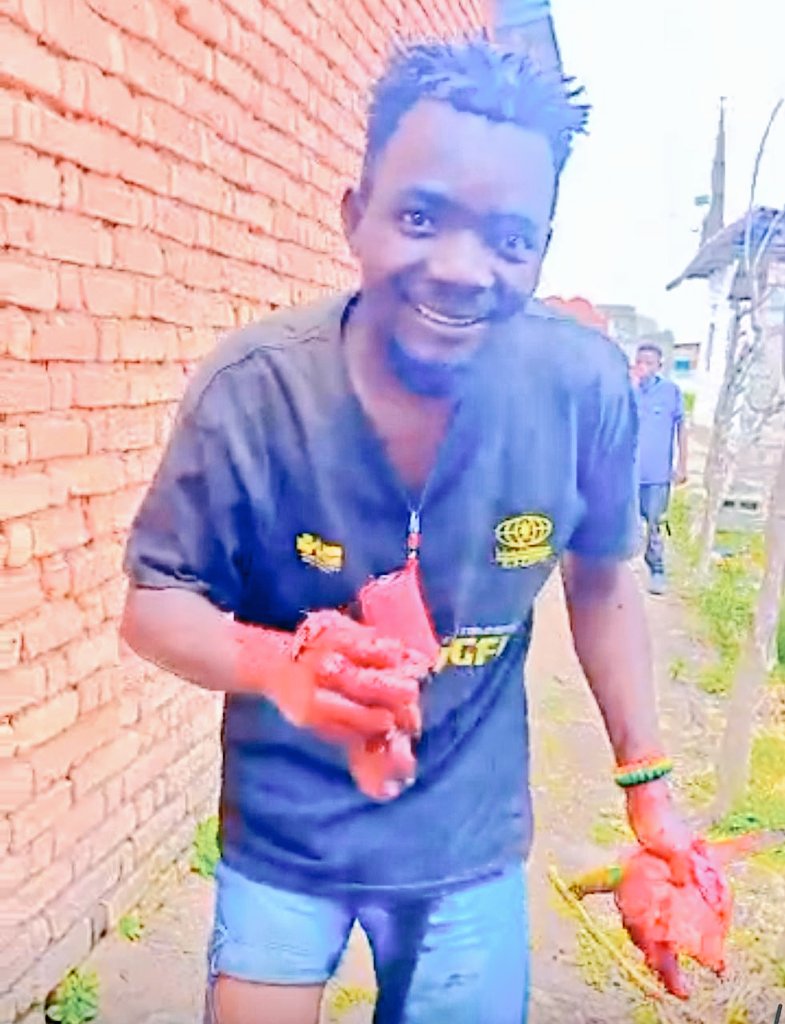
Disturbing images filmed in the city of Uvira before its reported capture by the M23 rebellion have surfaced, revealing acts of extreme violence allegedly committed by Wazalendo militiamen during a campaign of summary executions targeting civilians accused of being “infiltrators.”
The footage, extracted from a video recorded in Uvira, shows a Wazalendo fighter holding what appears to be a human heart following the execution of a person accused of collaborating with the M23.
According to accounts accompanying the video, the killing was justified by the perpetrators as part of a so-called “resistance against Rwandan Tutsi invaders,” rhetoric that local observers say has increasingly been used to legitimize violence against specific communities.
Human rights sources report that beginning on October 9, 2025, Wazalendo militias launched what they describe as a manhunt across Uvira. Civilians were allegedly arbitrarily labeled as “M23 spies,” arrested, and executed without trial, legal process, or any form of defense.
The reported death toll stands at at least ten people, nine of whom belonged to the Banyamulenge community, Congolese Tutsis from the Itombwe region. Among the victims was Munyakuri Pacifique, a young man who was reportedly shot multiple times in the head.
His body was left in public, an act described by witnesses as intended to terrorize an entire community.
According to the allegations, the killings were carried out exclusively by Wazalendo militiamen, operating in what critics describe as a climate of total impunity.
No formal report or condemnation of the incidents has been presented to the United Nations Security Council, nor have public reactions been issued by the European Union or the United States, despite the gravity of the allegations.
Amid this silence, questions are increasingly being raised about why these international actors have not held the government of President Félix Tshisekedi to account for the actions of allied militias operating on Congolese territory and the protection of civilians under its responsibility.
Residents and local observers say that in neighborhoods such as Salongo, militiamen conducted door-to-door searches, hunting individuals branded as “Rwandan infiltrators”—a term widely understood in local usage to refer to the Banyamulenge community.
Rights advocates stress that these incidents do not represent isolated abuses but rather a targeted campaign of persecution, marked by ethnic profiling, hate speech, and extrajudicial killings.
They warn that the ethnicization of the conflict and the absence of international accountability risk further fueling mass violence in eastern Democratic Republic of the Congo.
As of publication, Congolese authorities and international bodies had not publicly responded to the specific allegations related to the Uvira killings.