

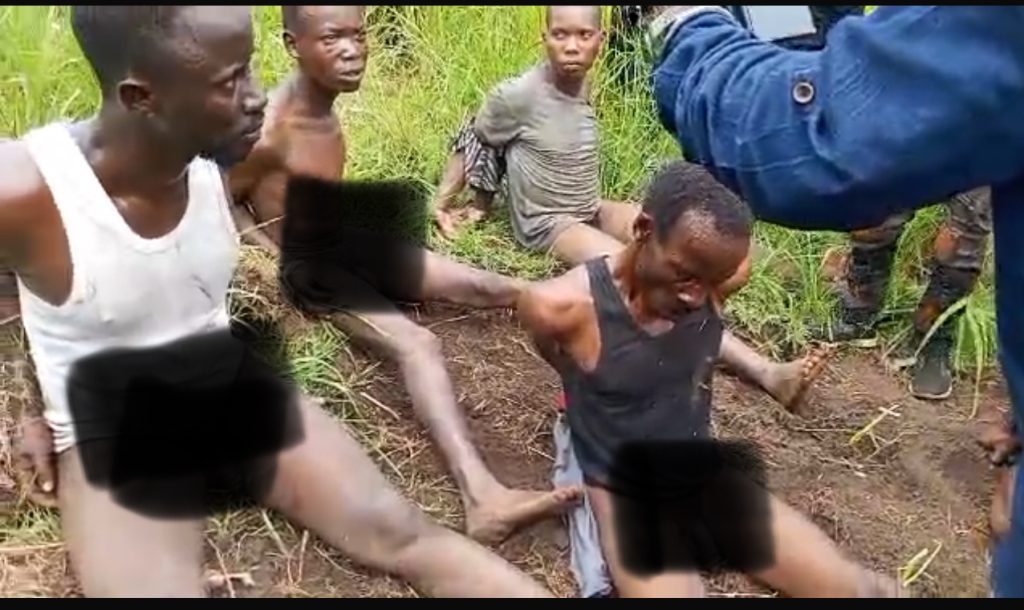
Katoto, Ituri Province — October 10, 2025. A new wave of violence has shocked Ituri Province after a group of young men from the Hema community were abducted and executed on the morning of October 8, 2025, in Katoto, a locality in the northern part of eastern Democratic Republic of Congo.
According to preliminary findings by Kivu Today’s investigative team, the victims were captured by a group of armed men identified by local witnesses as members of the CODECO militia, reportedly accompanied by elements of the FARDC (Armed Forces of the Democratic Republic of Congo).
Eyewitness accounts and video evidence obtained by Kivu Today suggest that the men were forcibly taken to a wooded area outside Katoto where they were subjected to severe abuse before being killed.
In recordings reviewed by our newsroom, one of the militia commanders is heard reporting to his superiors, boasting that their operation was intended to “clear” neighboring villages—an apparent reference to a wider campaign of ethnic targeting against the Hema population.
Investigators from Kivu Today describe the videos as distressing evidence of an orchestrated and symbolic act of ethnic violence, meant to send a message of fear and extermination to Hema communities across the region.
“This was not a random killing. It was an act of terror deliberately staged to humiliate and erase a people,” said a local human rights monitor in Bunia who requested anonymity for safety reasons.
Residents in surrounding villages have since fled their homes, fearing further attacks. Local civil society organizations say the brutality of the Katoto incident represents a new escalation in the pattern of targeted killings that has gripped Ituri throughout 2025.
What makes this episode particularly alarming is the alleged involvement of FARDC elements, who, according to several witnesses, participated in or facilitated the abductions.
If verified, this would mark yet another instance of collusion between national forces and armed groups in Ituri; a pattern repeatedly documented by local and international rights organizations.
“This case could expose the depth of state complicity in ongoing atrocities,” said a regional analyst based in Goma. “The videos are chilling not only for their violence but for what they reveal about the command structure behind these crimes.”
Kivu Today has independently verified the authenticity of two separate video recordings depicting the moments before and after the killings. The materials are being securely stored and shared with human rights documentation networks for verification and legal preservation.
Community leaders in Ituri have condemned the killings, calling on the Congolese government and MONUSCO peacekeeping forces to deploy urgent protection for civilians in the affected areas. “We are witnessing an organized campaign of extermination,” said a Hema elder in the area. “If the world remains silent, this will spread to other territories.”
In response to inquiries from Kivu Today, a local government official who was seen at the scene and refused to identify himself, denied any official involvement of army personnel in the incident, promising that “an internal inquiry will be conducted to identify and punish any soldier found complicit.”
However, survivors and local witnesses remain skeptical, citing years of impunity and failed investigations into similar atrocities.
Ituri remains one of the most volatile provinces in the DRC, where decades-old tensions between the Hema and Lendu communities have repeatedly flared into massacres and retaliatory attacks.
Despite government pledges to restore order, violence has intensified in 2025, displacing tens of thousands and deepening mistrust among communities.
Analysts warn that unless decisive action is taken, the Katoto massacre may signal the start of a new cycle of ethnically driven killings with potential to destabilize the wider region.
Kivu Today continues to investigate the chain of command behind the Katoto killings and the extent of collaboration between CODECO units and FARDC elements.
Digital forensic experts and regional partners have been engaged to verify the metadata and origin of the video evidence before submission to relevant accountability bodies.
Kivu Today will continue monitoring developments in Ituri and publishing verified updates as investigations progress.