

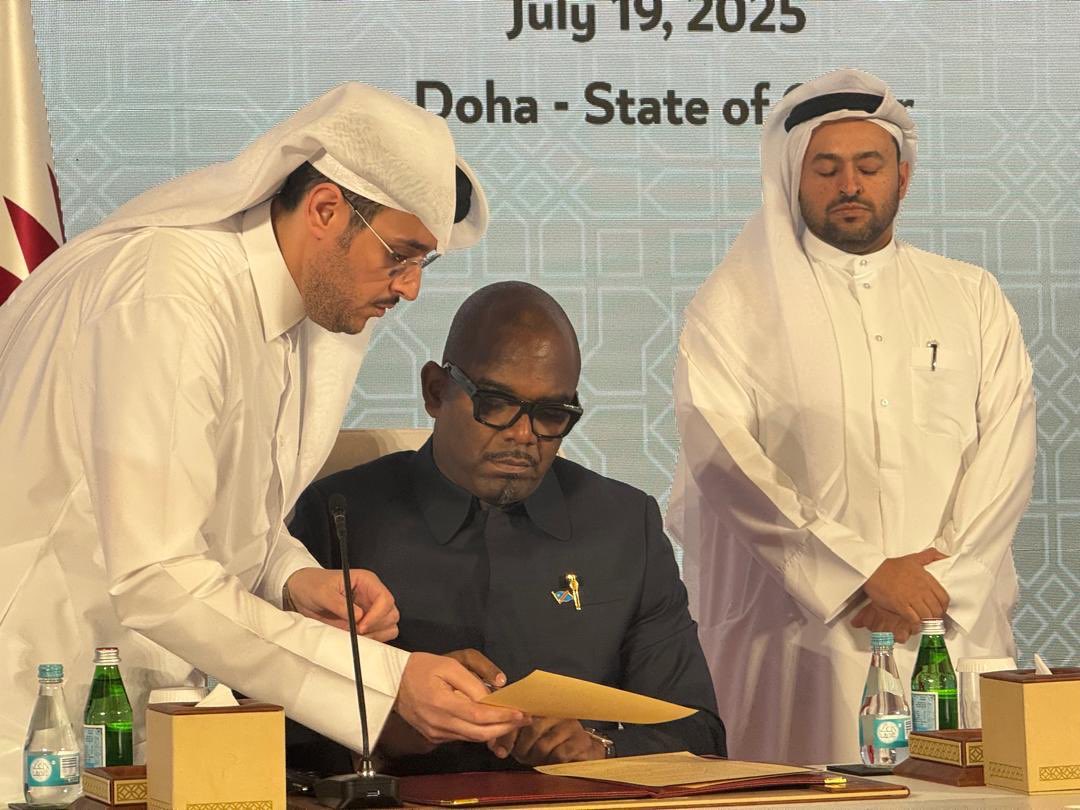
The recent Declaration of Principles signed between the Government of the Democratic Republic of Congo (DRC) and the M23/AFC in Doha is being hailed by some as a step toward peace.
But a closer look reveals a document that, while symbolically significant, raises more questions than it answers.
The agreement affirms that the conflict is political and security-related, and must be resolved through political means.
This acknowledgment aligns with M23’s longstanding argument that the problem is not criminal but rooted in governance failure, discrimination, and exclusion.
However, the agreement does not define what political resolution entails, nor how these grievances will be addressed structurally.
Both sides committed to an immediate ceasefire and to ending acts of provocation. Yet, the text provides no monitoring mechanism, timeline, or neutral guarantor to oversee compliance.
In a region where ceasefires have often collapsed within days, such vagueness makes the clause practically unenforceable.
The agreement also touches on the return of refugees and displaced persons “in dignity and safety.” This is critical, especially for Congolese Tutsi communities who have been in exile for decades.
However, it lacks details on how this return will be coordinated, protected, or supported. Past attempts at repatriation have failed due to violence and rejection from host communities.
Another key provision is the potential for amnesty, except for acts qualifying as war crimes, genocide, or crimes against humanity.
While common in peace negotiations, this clause could be selectively applied depending on who controls the judicial process. In the current Congolese context, where the judiciary is politicized, this creates risks for both sides.
The agreement allows the M23 to transform into a political party and participate in national life under Congolese law.
While this mirrors earlier deals, it lacks guarantees that such participation will be allowed in practice. Many former rebels who accepted such terms in the past were sidelined, arrested, or assassinated.
Crucially, the agreement avoids any reference to the FDLR, the genocidal militia long operating in eastern Congo and accused of collaborating with the Congolese army.
It also fails to address hate speech, ethnic profiling, or historical massacres—core drivers of the conflict.
In essence, the Declaration is a vague statement of goodwill.
 It lacks enforcement tools, timelines, or commitments from third-party guarantors. It creates space for dialogue but also leaves the door open for future betrayals.
Without serious follow-up and structural changes, the agreement risks becoming another symbolic gesture in a region where peace has often been promised but rarely delivered.