

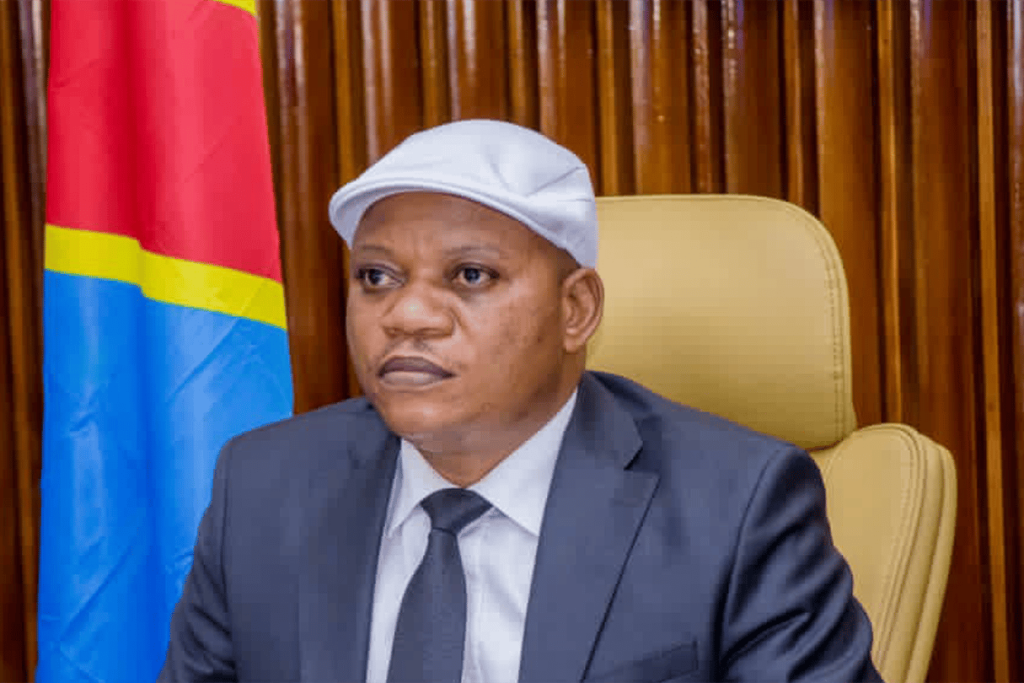
Jean-Marc Kabund-a-Kabund, once one of President Félix Tshisekedi’s closest allies, has emerged as one of his most outspoken critics, declaring that the Congolese head of state is “part of the problem” and cannot define the terms of a national political dialogue.
In a video interview published on February 20, 2026, by Jeune Afrique, Kabund outlined his vision for an inclusive inter-Congolese dialogue, arguing that the framework for such discussions cannot be set unilaterally by the president.
Kabund, a former interim president of the Union for Democracy and Social Progress (UDPS), broke with Tshisekedi in 2022 after being forced out of the ruling party.
The political rupture deepened in September 2023 when he was sentenced to seven years in prison for “insulting the head of state.” He was released in February 2025 after serving two and a half years in Makala prison in Kinshasa.
Since his release, Kabund has led opposition efforts through his party, the National Alliance for Change (ACH), denouncing what he describes as “the power of pleasure-seekers” and calling for structural political reforms.
During his visit to Europe, including Paris, Kabund insisted that any meaningful resolution to the Democratic Republic of the Congo’s political and security crisis must involve broad-based participation.
He rejected the notion that President Tshisekedi could set “red lines” for dialogue, arguing that such an approach undermines credibility and inclusivity.
Kabund also advocated for discussions that include armed groups, explicitly mentioning the AFC/M23, which, alongside its Rwandan allies, currently controls significant portions of North and South Kivu provinces.
His remarks underscore growing political tensions in the DRC, where calls for dialogue and reform continue to compete with deep divisions between the government and opposition figures.