

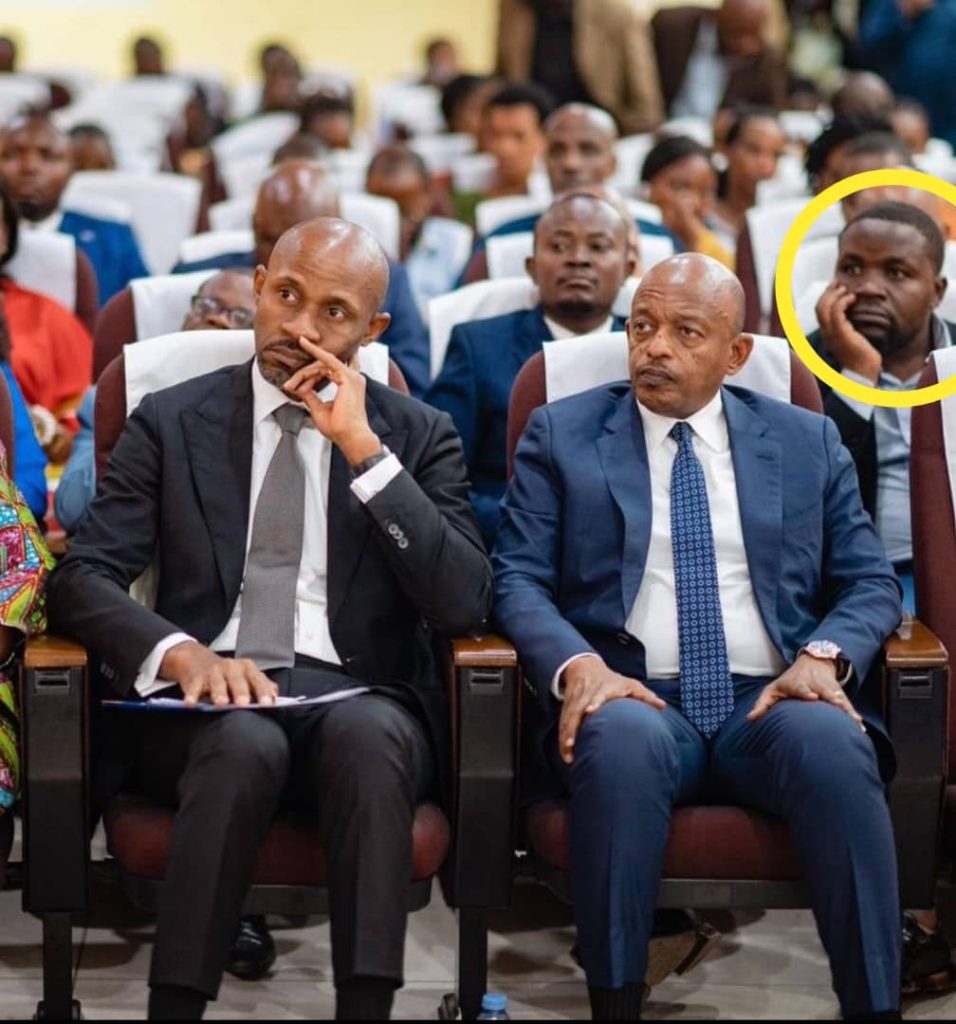
A solemn ceremony to honor the victims of one of the most horrific massacres in the Great Lakes region has spiraled into political controversy after photographs from the August 13, 2025 commemoration in Kinshasa revealed a troubling seating arrangement.
Innocent Rugero Rurindangabo, a figure widely known for organizing anti-Tutsi rallies in Goma, was seated directly behind Infrastructure Minister Alexis Gisaro, with Government Spokesperson Patrick Muyaya in close proximity.
The placement was not accidental. In DRC state protocol, such seating signals either trust, endorsement, or political relevance.
For many observers, it was an image that cut to the heart of a contradiction in Kinshasa’s politics: condemning genocide ideology in public speeches while offering public proximity to figures accused of fueling it.
The Gatumba massacre, which occurred on August 13, 2004, is remembered as one of the darkest chapters in the region’s recent history.
Armed men from the Burundian rebel group Forces Nationales de Libération (FNL), aided by members of the FDLR and Mai Mai militias, stormed a UN-run refugee camp in Gatumba, Burundi.
The camp housed Banyamulenge refugees — Congolese Tutsi from South Kivu — who had fled persecution in the Democratic Republic of Congo.
The attackers arrived in large numbers, singing hymns and beating drums.
They moved methodically from tent to tent, sparing non-Tutsi residents but shooting, stabbing, or burning alive over 150 people, including women and children. More than 100 others were injured. Witnesses recalled hearing chants of “We will exterminate all the Tutsis in Central Africa,” leaving no doubt as to the genocidal intent.
Despite initial outrage, justice for Gatumba has been elusive. Burundian courts opened a case in 2013 but stalled it a year later.
Key suspects like Agathon Rwasa, leader of the FNL at the time, remain politically active. Survivors, many now in exile, continue to demand accountability.
Human Rights Watch and Amnesty International have warned that the absence of justice perpetuates impunity and risks further ethnic violence.
Against this backdrop, the sight of Rugero at the Kinshasa memorial raised immediate questions. Protocol experts note that in formal state ceremonies, seating positions are carefully assigned.
“When someone is placed directly behind a minister, especially in an event of national sensitivity, it is not random,” a former government protocol officer told this publication. “It implies recognition — or at least tolerance — of that person’s standing.”
The symbolism struck many as bitterly ironic. The commemoration was meant to denounce ethnic violence and affirm the state’s rejection of genocide ideology.
Yet one of the most visible faces of anti-Tutsi mobilization in eastern Congo was seated in a position of honor. Neither Minister Gisaro nor Patrick Muyaya has addressed the matter publicly. The government has not explained how Rugero was given such a prominent spot.
For years, Rugero was a fixture in Goma’s street politics.
He led and coordinated anti-Tutsi rallies, often timed to coincide with military escalations involving the M23 rebellion or other Rwandophone-linked armed groups.
Human rights observers in North Kivu have long accused him of stoking ethnic hostility under the guise of patriotic protest.
Rugero’s sudden emergence in Kinshasa’s political space; especially so close to cabinet-level officials, has baffled analysts. Some see it as part of a broader Congolese tradition of absorbing street agitators into the national political framework, transforming their disruptive potential into political capital.
Others view it as a troubling sign that the government is willing to tacitly validate figures with extremist rhetoric when it suits its political needs.
For survivors of Gatumba, the controversy is more than a protocol misstep. It feels like a betrayal.
The massacre was not just an act of war, but an act of targeted ethnic extermination.
Seeing a known anti-Tutsi mobilizer accorded status at the very event meant to honor Tutsi victims undermines the integrity of the commemoration and raises doubts about Kinshasa’s true commitment to fighting genocide ideology.
Internationally, the optics could be damaging. Western diplomats and human rights organizations have increasingly scrutinized the DRC government’s handling of ethnic tensions, especially in the east.
The image of Rugero at the memorial risks reinforcing the perception that Kinshasa’s public condemnations of ethnic violence are undermined by its political practices.
The photograph is now circulating widely online. Whether the uproar will fade as another passing scandal or mark a turning point in the DRC’s handling of its ethnic politics remains to be seen.
But for many in the Banyamulenge community, the damage has already been done.