

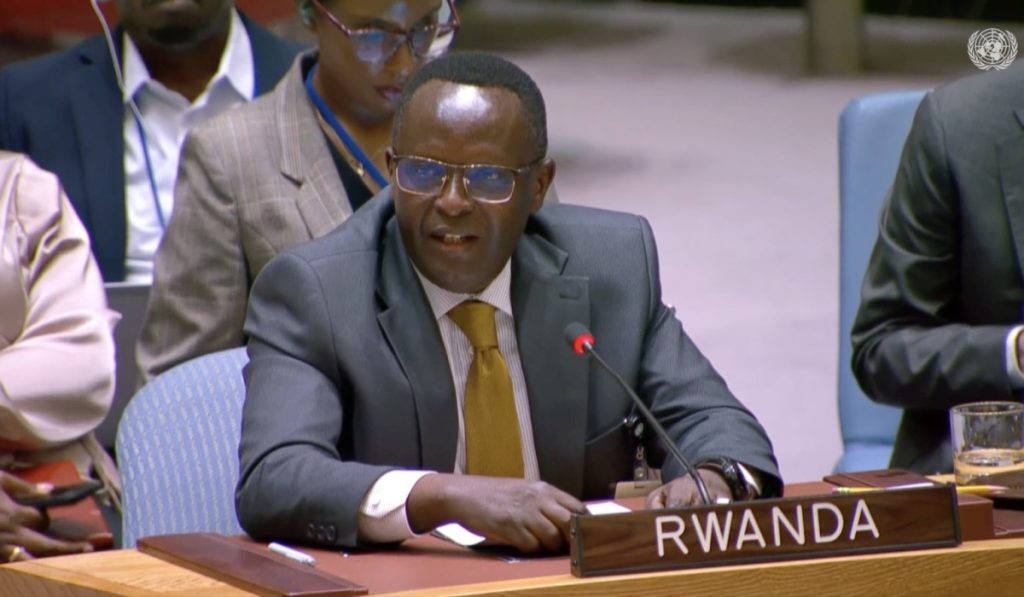
Rwanda has called on the United Nations peacekeeping mission in the Democratic Republic of Congo, MONUSCO, to urgently refocus its mandate and realign its efforts in light of a new peace agreement signed between Kigali and Kinshasa.
Addressing the UN Security Council on Friday, Rwanda’s Permanent Representative, Ambassador Martin Ngoga, delivered a pointed assessment of MONUSCO’s performance, highlighting decades of unfulfilled mandates—especially on the neutralization of the FDLR, a militia composed of remnants of the perpetrators of the 1994 Genocide against the Tutsi.
“This Council has passed no fewer than twenty resolutions over the past twenty-two years calling for the neutralization of the FDLR,” Ngoga told the chamber. “It never happened. What is lacking is not clarity but action.”
The ambassador’s remarks came just hours after Rwanda and the DRC signed a landmark peace agreement in Washington, brokered by the United States.
The deal establishes a Joint Security Coordination Mechanism and prioritizes the implementation of the Concept of Operations for the disarmament of the FDLR, along with the gradual lifting of Rwanda’s defensive posture—steps first agreed under the Luanda Process in 2024.
In this new context, Ngoga argued, MONUSCO must reevaluate its priorities and play a constructive, impartial role in implementing the agreement.
“By ignoring one matter—FDLR—and dramatizing the other—Rwanda’s defensive measures—MONUSCO rendered itself unable to effectively discharge its mandate,” he said. “This does not have to remain the case.”
Ngoga welcomed recent efforts by the mission to reengage meaningfully with actors on the ground, particularly the long-overdue meeting between MONUSCO Chief Bintou Keita and leadership of the M23/AFC movement in Goma.
“SRSG Keita’s engagement marks a constructive step forward and reflects what Rwanda has long encouraged: direct dialogue to foster mutual understanding,” he said.
However, Rwanda warned that MONUSCO must go further, ceasing what it called “public attacks” and “amplification of politicized narratives” that undermine trust.
“Instead of acting on these repeated Council mandates, MONUSCO has at times appeared to demonize any force or government that insists on implementing them,” Ngoga said.
He urged the mission to prioritize three areas: the impartial protection of civilians, facilitation of inclusive dialogue among all stakeholders, and the rejection of politicized discourse that undermines peacebuilding.
Rwanda also reiterated its long-standing view that only a negotiated political solution will bring sustainable peace to the Great Lakes region, and called for serious engagement with the AFC/M23’s demands for civil rights and political inclusion.
“The failure to address these issues through dialogue will only ensure the continuation of tension and the return of cyclical violence,” Ngoga warned.
In the wake of the peace agreement, Rwanda affirmed its commitment to work with MONUSCO, regional bodies, and the international community in good faith to ensure implementation and long-term peace.
The ambassador also emphasized the importance of balanced, non-politicized UN reporting as a tool for genuine problem-solving rather than selective narratives.
“As we mark the 80th anniversary of the United Nations, Rwanda reaffirms its unwavering commitment to peace and stability in our region and to constructive diplomacy,” he concluded.
The Security Council meeting marked a pivotal moment in the DRC file at the UN—one where the contrast between years of stagnation and the sudden emergence of a U.S.-brokered peace framework pushed MONUSCO and the wider Council to reconsider their role.
Rwanda’s message was clear: with renewed political will, peace is not only possible—it is overdue.