

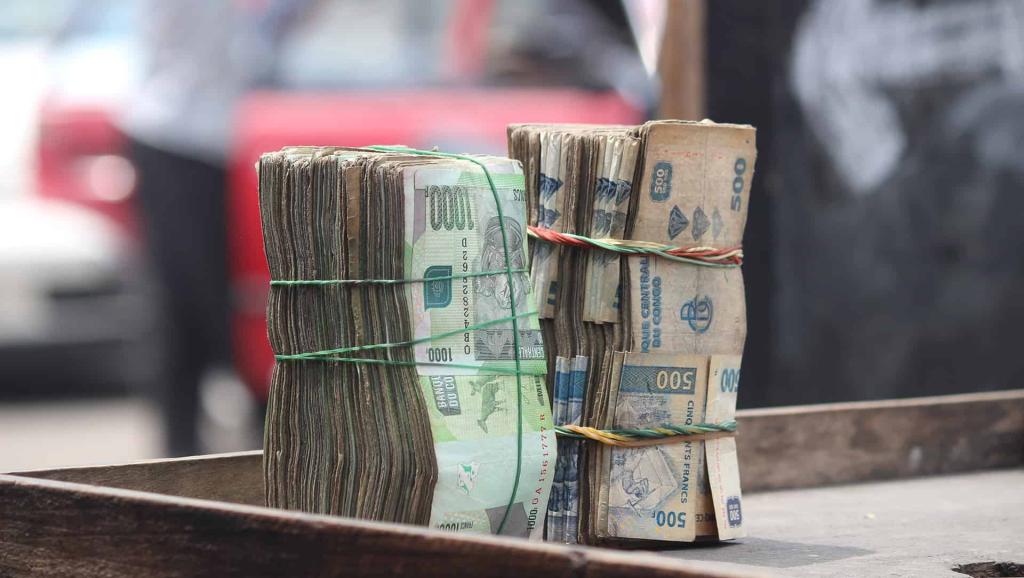
On a warm morning at the Goma no man’s land, money changers pile old Congolese franc notes, wrapped in rubber bands, the kind folded too many times, patched with tape, and passed hand to hand until they barely resembled money.
Since there is no alternative, many take them and leave, but some watching from a distance, you discomfort on the faces of their clients.
Many traders rejected them, shopkeepers argue, and ordinary people often lose value simply because their money looks worn out.
One woman laughed bitterly as she unfolded a shredded note. “I’ve had this since my father gave it to me. It’s almost like holding history, but it’s worthless now.” Scenes like this, repeated across Bukavu and Goma, illustrate the fragility of the system and the daily struggles of ordinary citizens.
Now, M23 government has ordered all damaged notes be exchanged at CADECO branches for fresh ones, free of charge.
At first glance, this may seem like a simple administrative exercise. But the reality is far more complex, touching human lives, local trade, cross-border commerce, and the very symbols of political authority.
Let me first give a snippet of the state of South Kivu, with its Bukavu capital, is one of DRC’s densest and poorest provinces, and about 9 million people, according to 2024 official figures, with 80 percent living below the poverty line.
North Kivu, with its capital Goma, has around 12 million people. Both provinces sit atop immense mineral wealth, including cobalt and copper, part of Congo’s estimated US$24 trillion in untapped resources. South Kivu is rich in Gold.
Yet conflict, corruption, and political instability divert these resources away from ordinary citizens and into the hands of armed groups. Poverty underpins the region’s armed conflicts, weak infrastructure, and tribal and primitive social structures.
This will give you context as we proceed later in this analysis. That’s one.
Two; at the borders of Goma, Bukavu, Bunagana, and Bunia, money changers pile old Congolese francs like dried fish. It’s a common scene. Peculiar here is the extreme dilapidation of the notes, some barely passing as legal tender.
One young trader joked, holding a crumpled note, “This money has survived wars, floods, and funerals. Maybe it should get its own pension.” Humor masks a serious trut; the state’s grip on its currency is weak, leaving citizens trapped in an unpredictable financial system.
I recently went shopping in the commercial area of Birere slum in Goma. The area was bustling and vibrant, pure trade in motion. Yet everywhere I looked, the disdain for old francs was palpable.
Vendors and customers preferred dollars whenever possible. After running my errands, I entered a popular pub and restaurant that belongs to an Indian businessman, Congolese-born and raised, to grab a drink and quench my thirst. “If someone offers me francs like these, I tell them I prefer dollars. I can’t risk losing value in this mess,” he tells, jovially.
Earlier, I had interacted with a mother selling merchandise. She told me how she often receives torn notes and she returns torn notes too, thus everyone fears overpaying or losing once it’s rejected elsewhere after.
A school staffer I had visited told me, “It takes extra time to verify and count these notes. Sometimes we reject them, causing arguments.”
But now with the announcement of new notes available for picking, the big question across the Kivus is where did the new banknotes come from?
Officially, Kinshasa has not confirmed sending them. Yet M23 has not officially claimed printing the new notes. They are currently reviving CADECO, a grassroots cooperative bank first established in the 1980s and abandoned after Kinshasa tightened control. By reopening it, M23 exchanges old notes and positions itself as the financial lifeline of the Kivus.
It’s the same Congolese franc still in use, now managed by parallel authorities, almost like a government within a government.
From my analysis, this also functions as a test of an independent financial layer; a practical experiment to explore how an autonomous central bank or new currency could operate if M23 seeks to establish a future state. Each transaction measures financial autonomy, governance capacity, and public compliance.
Three; in recent months, M23 has displayed an unprecedented paradox: taxes and revenues fund both civilian services and military operations. Roads, hospitals, schools, water, electricity, and local security coexist alongside funding for armed conflict against FARDC and allied groups. This dual-purpose management of resources is historically unparalleled for a rebel movement.
Note that M23 is highly secretive and is not answerable to any international body. They do their things as they wish. So, let’s attempt to answer the question about how they secured the new notes.
Speculating from standard banking and security practices, the money could have been secured through armored transport, covert airlifts, or private networks. Regardless, Kinshasa has no effective control over currency in eastern provinces. What President Félix Tshisekedi thought was a chokehold is exposed as weak. The central bank governor must grapple with the impossibility of monitoring or controlling flows. There is no practical way to estimate the volume of currency circulating or the economy’s cushion against inflation or instability; a frightening reality.
What does that imply? M23 is tightening the noose. Tshisekedi is squeezed against a hard rock. In large parts of Northern and Southern Kivu, people can walk freely, trade safely, and access basic services. Life is arguably safer than it has been in decades. M23 cannot be ignored nationally, regionally, or globally. Yet this does not erase the government’s continued posture of primitive politics, persecution, and ethnic targeting. One thing is clear: M23 will secure the largest part of what it demands, if not all.
Three; money is trust. In Kinshasa, Tshisekedi should hold authority, yet M23 now controls part of it. Citizens benefit: torn notes are replaced, transactions smoother, salaries arrive on time, and cross-border trade with Rwanda, Uganda, and Burundi is more predictable. Yet these gains conceal a dangerous precedent: a parallel system with taxation, trade regulation, and monetary management operates under the national currency.
This undermines central authority, complicates oversight, and increases risks of money laundering, black-market activity, and financing for armed groups.
Four; adding to the irony, Congolese cross into Uganda, Rwanda, and Burundi to bank money, withdraw funds, and access sister accounts. Eastern DRC operates as an auxiliary banking system under the national currency’s appearance. Financial experts are witnessing an unorthodox experiment in parallel governance, financial sovereignty, and human adaptation under conflict.
For Tshisekedi, this is not a technical challenge but a direct political and symbolic blow. Currency represents state authority. If a rebel movement can administer banking, taxation, and trade while using the national currency, central government fragility is exposed. Issuing a new currency to cut off the Kivus is theoretically possible but practically daunting: new designs, secure printing, mass distribution, and public education would be required. In Congo’s fragile economy, this could trigger inflation, panic, and black-market proliferation.
Five; stopping M23 risks the broader economy; letting them continue consolidates parallel governance. This is a test of Tshisekedi’s problem-solving skills, negotiating ability, and willingness to prioritize the country over personal pride. How he responds may define his leadership for years.
The streets of Bukavu and Goma buzz with anticipation. Citizens will line up at CADECO branches, clutching bundles of worn notes. A trader in Bukavu on the telephone happily told me, “Finally, I don’t have to fear my children’s school fees will be worthless tomorrow.” And the school finance officer in Goma noted, “We can now accept fees with confidence. It is still M23, but at least it works.”
Beneath optimism lies a contest over Congo’s financial soul. M23 is not merely distributing clean currency; they are redefining power structures, showing that financial control can rival military strength, and demonstrating governance rarely seen in a rebel movement.
Remember earlier I mentioned South and North Kivu host some of the country’s poorest populations, with food insecurity, mass displacement, fragile infrastructure, and dependence on local markets.
All that considered, since the world rarely so uses the plight of the people of Eastern DRC, the suffering and the agony, preferring to focus on mineral wealth worth trillions, which had remained largely inaccessible, fueling competition among armed groups, now the tides have changed. M23 is saying; “we will fix our situation; secure our safety and then manage our resources.”
It’s an interesting concept.
Finally; as the sun sets over Bukavu and Goma, mothers clutch newly exchanged notes, traders tally earnings, and children hurry home from schools now cautiously accepting cleaner francs.
Across borders, Congolese carry money into Rwanda, Uganda, and Burundi, tapping sister banks while navigating a financial reality that defies conventional rules.
Take it or not, M23 has created a living laboratory where currency, governance, and conflict intersect, challenging national authority and international observers alike.
This parallel system; managing currency, taxes, and civil services while leveraging a national currency; defies textbook economics and tests Tshisekedi’s leadership, vision, and problem-solving skills.
The eastern DRC now serves as both a laboratory and a warning: fragile states can generate functioning parallel systems, and the outcomes; positive or catastrophic, will hinge on central authorities’ response.
In the Kivus, money has become more than currency; it is power, trust, and a mirror reflecting the fragile state of the nation at a crossroads.
Let’s watch and see what happens next.