

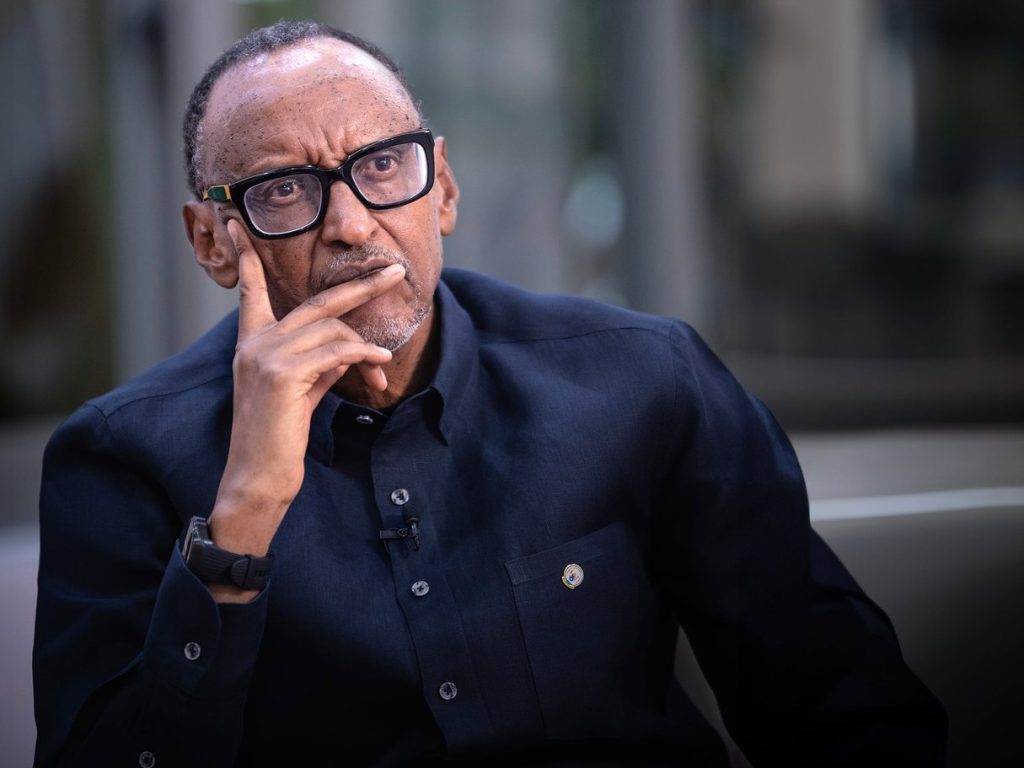
Rwandan President Paul Kagame has defended his country’s security posture in Eastern Democratic Republic of Congo, rejecting international criticism and sanctions while insisting that Rwanda’s actions are necessary to protect its borders.
In an interview with Jeune Afrique, Kagame pushed back against growing pressure from Western governments, including recent sanctions targeting Rwandan officials. He argued that Rwanda is being unfairly blamed for a conflict it did not initiate.
“This conflict did not originate from Rwanda,” Kagame said, emphasizing that longstanding instability in eastern Congo continues to pose a direct threat to his country.
He described international responses as overly simplistic, accusing critics of ignoring the deeper causes of the crisis.
At the center of the dispute is Rwanda’s alleged military presence in eastern Congo and its reported links to the M23 rebel group.
Kagame did not deny that Rwanda has taken action beyond its borders, but framed such moves as “defensive measures” aimed at neutralizing threats.
“If there is a threat against us, why should we remove our defensive measures without addressing that threat?” he said.
The Rwandan leader also criticized what he described as “selective” diplomacy, particularly from the United States, which has called for the withdrawal of Rwandan forces.
Kagame argued that peace agreements in the region place obligations on multiple parties and should not be enforced unevenly.
“It cannot be that one side is expected to fulfill its obligations while others choose whether to act or not,” he said.
Kagame further dismissed claims that Rwanda is becoming diplomatically isolated, suggesting that such interpretations reflect political bias rather than reality. He maintained that sanctions and criticism would not alter Rwanda’s core security priorities.
“Should I compromise my country’s security to preserve reputation?” he asked.
On the ground, Kagame pointed to what he described as improved conditions in areas such as Goma and Bukavu, arguing that the current situation offers greater stability than before. He also said that security along Rwanda’s border has strengthened.
“There is no question the border is more secure,” he stated.
Relations between Rwanda and the Democratic Republic of Congo remain strained, particularly between Kagame and President Félix Tshisekedi.
Kagame indicated there is no immediate resolution in sight but signaled patience, saying he is prepared to wait for conditions to improve.
Beyond the regional conflict, Kagame addressed broader concerns about Rwanda’s international standing. While acknowledging that sanctions could carry reputational costs, he suggested such measures are often driven by geopolitical interests rather than objective assessments.
In a separate issue, Kagame also raised the possibility of withdrawing Rwandan troops from Mozambique if financial support for the mission is reduced, stressing that such deployments must be sustainable.
“It is not a threat—it is reality,” he said, noting the financial burden of maintaining overseas operations.
Despite mounting international scrutiny, Kagame’s message remained consistent: Rwanda will continue to prioritize its national security, even in the face of external pressure.
“We will not remove defensive measures while the threat remains,” he said.