

The United States’ effort to broker peace between Rwanda and the Democratic Republic of Congo was not driven by security concerns alone. It was also part of a broader campaign to open Congo’s enormous mineral sector to American and allied investors, according to a sweeping investigation by Tablet Magazine that raises questions about how diplomacy, private relationships and commercial interests became intertwined under President Donald Trump’s administration.
The investigation, titled “The Family Business,” was written by Armin Rosen and published on July 9, 2026. It centres on Massad Boulos, the US State Department’s senior adviser for Africa, whose son Michael is married to Trump’s daughter, Tiffany.
Its central argument is not that the Rwanda–Congo peace process had no value. Rather, Tablet portrays the diplomatic initiative as a fragile political settlement that was increasingly used as the vehicle for a more concrete objective: creating conditions in which US-linked companies could compete for Congo’s copper, cobalt and other strategic minerals.
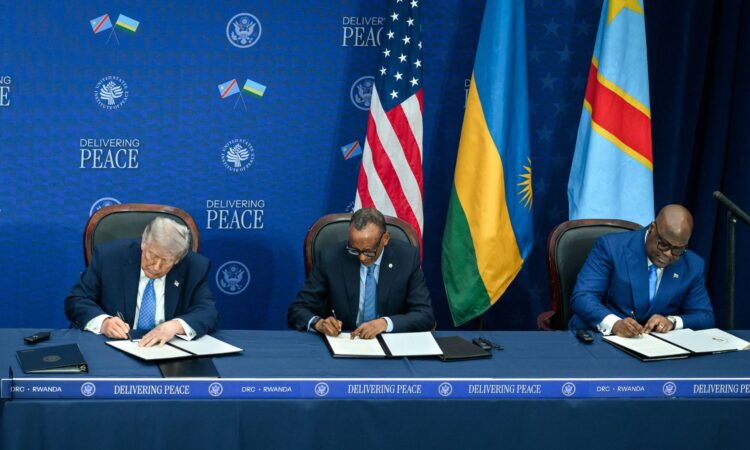
Tablet says Boulos’s first major diplomatic achievement was the December 4, 2025 signing ceremony between President Paul Kagame and Congolese President Félix Tshisekedi in Washington.
The ceremony was held at what the magazine describes as the newly renamed Donald J. Trump Institute of Peace. According to Tablet, professional staff at the US National Security Council and State Department believed that staging such a high-profile event was premature because the diplomatic process had not yet produced a visible change on the battlefield.
Boulos reportedly disagreed. One source familiar with the negotiations told the magazine that he believed a major Washington ceremony could act as a “forcing mechanism,” pushing Rwanda and Congo toward a more substantial settlement.
The event was delayed several times while Boulos attempted to persuade Kagame and Tshisekedi to appear before Trump and formally commit themselves to ending one of Africa’s longest conflicts.
Yet even the ceremony reportedly exposed the depth of the distrust between the two governments.
Tablet claims that Kagame and Tshisekedi arrived in Washington believing that different and incompatible commitments had been made to them. The magazine says US Vice President JD Vance at one point took the two leaders aside and told them that a treaty-signing ceremony was not the place to renegotiate their outstanding differences.
Neither president referred to the other by name during the public remarks, according to the report. They did not shake hands and appeared not to look at each other.
Tablet interprets that body language as evidence that the two African leaders understood the fragility of the arrangement more clearly than its American architects.
That interpretation is strongly worded and reflects the magazine’s analysis. Tablet does not publish the alleged contradictory promises, identify exactly who made them or provide detailed responses from Kagame, Tshisekedi or their governments on that specific allegation.
The magazine also argues that the process was structurally incomplete because the armed actors controlling events in eastern Congo were not direct participants.
It says there are at least 120 armed groups operating in eastern DRC and notes that the M23 movement was not involved in the US-led negotiations. Tablet describes M23 as “a Rwandan proxy army,” repeating an accusation frequently made by Kinshasa and some foreign governments.
Rwanda has long disputed the characterisation that it simply controls M23. Kigali has argued that the conflict is rooted in the failure of successive Congolese governments and their international partners to address the FDLR, an armed group created by elements linked to the 1994 Genocide against the Tutsi, as well as persistent persecution and exclusion affecting Congolese Tutsi communities.
That Rwandan security argument receives limited attention in the Tablet report. This is a major weakness in its treatment of the Rwanda–Congo conflict because it analyses Washington’s motives in depth but gives much less space to the historical and security calculations driving Kigali.
Tablet says that two days after the Washington ceremony, M23 intensified its operations against Congolese forces in the Uvira area of South Kivu. The magazine presents this development as evidence that the agreement had failed to alter realities on the ground.
But Rwanda has previously rejected the claim that developments around Uvira were an unexpected act of defiance against the Washington process.
President Kagame has argued that fighting around Uvira had been developing for weeks and months before the December 4 signing and that Washington had been regularly informed about the situation.
“The United States had been informed during almost day in, day out, week in, week out,” Kagame said in an interview contained in a separate document in the user’s files. He argued that Uvira could not reasonably be presented as an event that suddenly occurred after the agreement in deliberate disregard of Washington.
Kagame has also insisted that Rwanda’s obligations under the peace framework cannot be implemented independently of Congo’s responsibility to eliminate the security threat posed by the FDLR.
“We refuse to remove defensive measures, whether it means troops or troops and whatever else,” Kagame said, arguing that it would be illogical to demand the removal of defensive measures while leaving the underlying threat intact. He said the compromise was already reflected in the Washington agreement and earlier arrangements that, in Rwanda’s view, Congo had failed to respect.
He has further called on the United States to apply pressure evenly.
“The United States that also brought us together…are also obliged to make sure that they are really pushing us, Congo and Rwanda, in the right direction, even-handedly,” Kagame said. He warned that placing the burden principally on Rwanda while treating other parties more lightly would not produce a sustainable outcome.
These statements matter because they complicate Tablet’s argument that the Uvira developments simply demonstrated the “worthlessness” of the Washington agreement. They show that Rwanda viewed the agreement as a reciprocal security framework, not as a unilateral obligation to withdraw its defensive measures regardless of developments involving the FDLR and the Congolese state.
However, the strongest part of the Tablet investigation is not its battlefield analysis. It is its examination of the commercial machinery surrounding the peace process.
According to the magazine, Congo holds mineral reserves valued at an estimated $24 trillion, including copper, cobalt and rare earth materials central to electric vehicles, batteries, defence manufacturing, electronics and advanced technology.
Tablet says Chinese state-backed companies already dominate major parts of Congo’s extractive economy. Unlike many American companies, those firms can operate with extensive government backing and fewer domestic legal and compliance restrictions.
The magazine argues that reducing this dependence on China and creating safer conditions for American companies is a legitimate US strategic objective.
“It is in the US national interest to change this reality, and to create geopolitical conditions in which it becomes possible for Americans to operate there,” Rosen writes.
The controversy begins with the companies that were reportedly promoted as part of that effort.
One of them was Virtus, a Wyoming-based company founded by retired US Special Forces officers. In early 2024, Virtus began pursuing the acquisition of part of Chemaf, a major copper-and-cobalt operation in southeastern Congo.
Tablet says the Virtus executives did not have a previous mining track record but had extensive experience as private contractors in conflict environments. The company nevertheless appeared to have put together financial and technical partners capable of supporting the transaction.
In January 2026, the magazine reports, White House staff member Alex Flemister informed Virtus chief executive Phil Braun that a Turkish company called BGN was interested in joining the Chemaf transaction.
According to two sources cited by Tablet and records of the discussions, Braun was initially reluctant. Adding another company at a late stage risked complicating an already difficult transaction.
Flemister nevertheless reportedly pressed the issue.
“The president says he likes ribbon-cuttings, not groundbreakings,” one Washington source told the magazine, apparently referring to Trump’s preference for deals that could be announced and presented as immediate achievements.
Virtus representatives met BGN at least twice, according to the investigation: once at a law firm near the Old Executive Office Building in Washington and again during the February 2026 Mining Indaba in Cape Town, South Africa.
Tablet says it was not clear what BGN would contribute. The company was known primarily as a trader of oil, gas and refined petroleum products, not as an operator in Central African copper-and-cobalt mining.
Virtus ultimately proceeded without BGN.
The magazine says another attempt was made to introduce BGN into a separate Congo mining arrangement.
Mercuria, an international commodities trader, and Gécamines, Congo’s state-owned mining company, were negotiating a US government-supported mechanism for marketing cobalt and other Congolese minerals.
The agreement was reportedly expected to be announced in June 2025 at the US–Africa Business Summit in Luanda, Angola.
Citing two Washington-based sources familiar with the discussions, Tablet alleges that Boulos slowed various approvals for more than five months while seeking to have BGN incorporated into the arrangement.
Boulos’s representative referred the allegation to the State Department, which denied it.
The magazine then examines the relationship between BGN’s leadership and the Boulos family.
BGN is led by Ruya Bayegan, a Turkish-Serbian energy trader. The New York Times previously reported that Michael Boulos and Tiffany Trump had vacationed aboard the Phoenix II, a megayacht owned by Bayegan and her husband.
According to the Times account cited by Tablet, chartering the yacht had previously cost approximately $1.3 million a week. Bayegan’s spokesperson told the Times that Bayegan was not aboard during the Boulos-Trump visit.
Boulos’s Washington representative told Tablet that Bayegan was merely “a social acquaintance” and that Michael Boulos was personally friendly with her son.
The State Department also told Tablet that it had no objection to American companies working with BGN.
“We remain committed to working with Türkiye and other countries to advance US commercial interests,” a department spokesperson said.
BGN denied that its commercial growth resulted from political influence or personal favour.
In correspondence quoted by Tablet, lawyers representing Bayegan said she had no commercial or professional relationship with Boulos and rejected “any suggestion that commercial opportunities were obtained through political influence, personal favour or improper relationships.”
The lawyers said BGN’s success was “driven by the strength of its business.”
Boulos also told Africa Intelligence that he had never held any interests in BGN and had never engaged in professional favouritism involving any company.
Tablet places the Congo story within BGN’s wider international expansion.
The magazine says Bayegan began trading oil in Kazakhstan, later entered a gas-purchase agreement with the Abu Dhabi National Oil Company and established a significant position in Indonesia’s gas-import market.
It also describes BGN as being deeply involved in Libya, where opaque oil-trading arrangements and political divisions created opportunities for international commodity firms.
The report draws on Africa Intelligence and the Financial Times in examining BGN’s Libyan operations. It also cites findings attributed to Libya’s Audit Bureau and a United Nations expert panel, which had raised concerns about opacity, inflated costs, fuel diversion and weaknesses in the prequalification of participating companies.
BGN disputed parts of the Libyan Audit Bureau’s findings, describing them to the Financial Times as containing “regrettable inaccuracies.”
The magazine’s international trail also includes Turkey, Serbia, the United Arab Emirates, Indonesia, Kazakhstan, Angola, South Africa, Libya, Nigeria, Egypt and Algeria. These countries appear not as incidental references but as parts of the political and commercial networks through which American Africa policy was being conducted.
The DRC was therefore one part of a far wider diplomatic portfolio placed under Boulos.
US State Department spokesperson Tommy Pigott told Tablet that Boulos had played a central role in the Rwanda–DRC Washington Accords, pushed progress toward unified government and elections in Libya, supported diplomacy on Western Sahara, advanced peace initiatives in Sudan, promoted security in the Horn of Africa and the Red Sea, and participated in Nile Basin negotiations involving Egypt and Ethiopia.
Tablet argues that this mandate was unusually broad for a single official, particularly one who had not been confirmed by the US Senate.
Boulos was appointed senior adviser for Africa in April 2025. The magazine reports that he was classified as a Schedule C political employee, generally one of the lower formal categories of political appointment, while operating as a high-level interlocutor with African presidents, foreign ministers and intelligence officials.
Under the legal framework discussed in the article, officials exercising “significant authority” may be required to undergo Senate confirmation or be covered by specific congressional notifications.
Tablet says it found no evidence that Boulos had faced a Senate vote or that the administration had submitted the required justification for an extension of his service. The State Department declined to tell the magazine whether such notifications existed.
The department said only that, “As Senior Advisor, Mr. Boulos is performing functions as outlined by the Secretary of State consistent with applicable laws and procedures.”
Tablet also says it could not locate Boulos’s public financial disclosure, known as OGE Form 278e, in the US Office of Government Ethics database.
An unnamed State Department spokesperson responded that Boulos was “compliant with all employment requirements.” The department declined to say whether he had submitted the form.
The magazine notes that Boulos was not called to represent the State Department during a January congressional hearing on the Rwanda–Congo peace process. Instead, the department sent Deputy Assistant Secretary Sarah Troutman, even though Tablet describes the Washington agreement as Boulos’s signature diplomatic achievement.
This lack of institutional visibility is important to the story because Boulos was not operating at the margins of the Rwanda–Congo negotiations. He was one of their main architects, while simultaneously dealing with governments and private companies interested in the commercial opportunities that might follow a peace settlement.
The State Department has rejected suggestions that he blurred public and private interests, describing such claims in earlier responses as a “dishonest and deliberately misleading attempt” to distract from what it called his “tremendous successes.”
Boulos has said that he works through State Department procedures to advance American interests.
He also described Tablet’s investigation as a “hit piece” based on recycled false reporting and warned that publication of false or defamatory allegations could expose the magazine to legal liability.
The article ultimately acknowledges an important limitation.
“In Boulos’ case, there is no direct proof of corruption, nor has he ever been formally accused of it,” Tablet writes. “There are no contracts or records of payoffs.”
Instead, the magazine argues that there is an unusually large potential for future commercial benefit created by months of access to African and Middle Eastern leaders, governments, investment processes and strategic assets.
Pigott defended Boulos, saying he had “embodied the results-driven, America-first diplomacy that President Trump has championed.” Boulos separately told Africa Intelligence that his only objective was to advance US interests and that his involvement with Libya was entirely diplomatic.
The most consequential conclusion for Rwanda and Congo is therefore not that the Washington process was fraudulent or meaningless.
It is that peace was being pursued through an American model in which security arrangements, mineral access, commercial deals and personal diplomacy were treated as parts of the same negotiation.
That approach can produce speed. It can bring presidents into the same building, mobilise investors and place enormous pressure on governments that might otherwise remain locked in conflict.
But it also carries serious risks.
A mineral agreement can be signed while armed groups remain active. An investment announcement can be celebrated while the FDLR question, refugee grievances, ethnic persecution, M23’s political demands and Congo’s governance crisis remain unresolved. A Washington ceremony can create diplomatic momentum without guaranteeing peace in Uvira, Goma, Bukavu or the wider Kivu region.
Tablet’s investigation is strongest where it exposes this tension.
Washington viewed Congo’s estimated $24 trillion mineral wealth as a strategic prize that should no longer be dominated by China. Rwanda and Congo viewed the negotiations through the more immediate questions of national security, armed groups, territorial authority and political survival.
The resulting agreement was expected to carry all these burdens at once.
That may be the real story behind the Washington Accords: peace was not simply the final objective. It was also the political gateway through which governments, diplomats and private companies hoped to enter one of the most valuable mineral territories in the world.
Interesting read. Well informed investigative journalist. The conclusion and analysis of Washington Peace deal without including those who matter the most in the deal will remain a mere paper agreement. Too many back and fourth and one wonders until when?