

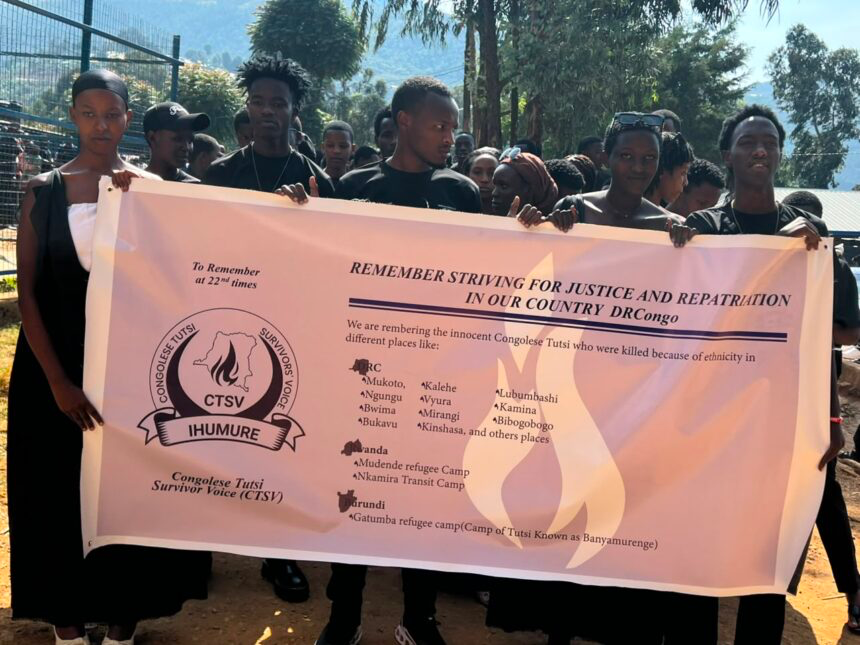
Congolese Tutsi refugees at Kiziba Refugee Camp in western Rwanda have renewed calls for justice and a safe return to their homeland as they commemorated members of their community killed in decades of violence across the Great Lakes region.
The commemoration, held for the 22nd time, remembered victims of killings in the Democratic Republic of Congo, the 2004 Gatumba massacre in Burundi, and earlier attacks against Congolese Tutsi refugees at Mudende in Rwanda.
For many at Kiziba, the ceremony was not simply about the past. It was also a reminder that thousands of Congolese Tutsi remain refugees, years after fleeing persecution and conflict in eastern DRC.
Méthode Nsengiyumva, president of Kiziba Refugee Camp, said the community continues to question why Congolese Tutsi have repeatedly been targeted in a country inhabited by hundreds of ethnic communities.
“Congo has many ethnic groups, but we Tutsi have been persecuted,” Nsengiyumva said. “We ask the international community to act to stop the killings of Tutsi and create conditions for refugees to return to their country.”
Léandre Karekezi, who oversees the camp, said remembering the victims was not intended to reopen old wounds, but to preserve the history for younger generations and reinforce the principle of “never again.”
Elders at Kiziba, located in Rwankuba Sector of Karongi District, urged younger refugees to understand the history of the DRC and maintain their connection to their country, even after spending years in exile.
The commemoration was held under the theme, “Remember, rebuild ourselves, pursue justice and return home.”
Particular attention was given to the Gatumba massacre of August 13-14, 2004, when more than 160 Congolese refugees, predominantly Banyamulenge, were killed at a refugee camp in Burundi.
Benjamin Ndizeye, who gave testimony during the ceremony, linked the events preceding the massacre to fighting in eastern DRC involving forces associated with Colonel Jules Mutebutsi and General Mbuza Mabe. The violence drove Congolese Tutsi civilians across the border into Burundi in search of safety.
Ndizeye said questions remain over why the refugees were settled close to the DRC border and why security forces stationed nearby failed to stop the attack.
“Looking at how the killings were carried out, it is clear to us that they were planned,” he said, arguing that the circumstances surrounding the attack raised questions about possible complicity.
Survivors and representatives of the refugee community say the Gatumba massacre forms part of a much longer history of violence against Congolese Tutsi communities.
They estimate that more than 15,000 Congolese Tutsi have been killed in successive episodes of violence in the region, although that cumulative figure has not been independently verified.
Twenty-two years after Gatumba, the message from Kiziba remains largely unchanged: remembrance must be accompanied by justice, protection for communities still at risk, and ultimately the possibility for refugees to return safely to the country they still consider home.