

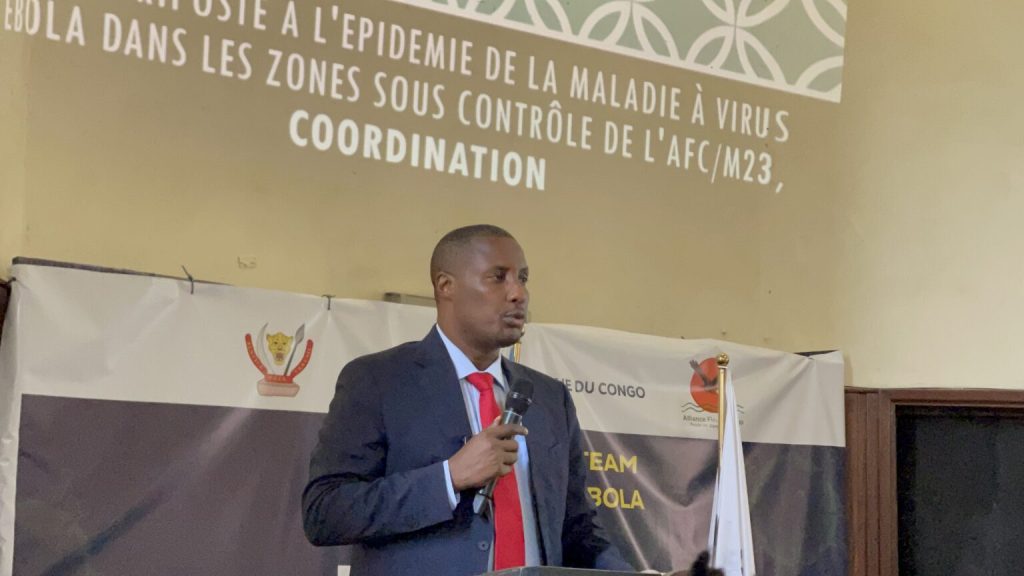
Health authorities in eastern Democratic Republic of the Congo have launched a new public information and coordination platform aimed at strengthening the response to the ongoing Ebola outbreak caused by the Bundibugyo virus.
The website, ebolariposte.org, was introduced by the Health Crisis Unit (CCS) established by AFC-M23 to provide residents with real-time updates on the epidemic, response measures, and public health guidance. The platform serves communities in Goma, Bukavu, and surrounding areas, where authorities say surveillance and containment efforts have been intensified.
The portal centralizes epidemiological data, tracks confirmed cases, monitors identified contacts, and provides prevention guidelines. In Goma, health teams are focusing on enhanced surveillance, contact tracing, and treatment in dedicated Ebola care centres.
In Bukavu, officials have recently assessed molecular biology laboratories and treatment facilities, including the Ebola treatment centre in Lwiro, to evaluate preparedness and response capacity.
The website urges residents to observe key preventive measures, including frequent handwashing, maintaining physical distance where possible, avoiding contact with people showing symptoms of Ebola or with the bodies of those who have died from the disease, and immediately reporting any suspected infections.
Authorities have highlighted two emergency contact numbers operating around the clock: +243 900 900 500 and the confidential hotline 1510.
“The response continues. Every life counts. Let us remain united and vigilant,” reads a message displayed prominently on the platform, which also acknowledges the support of international partners including the World Health Organization (WHO), Médecins Sans Frontières (MSF), UNICEF and the Red Cross.
The launch of the portal comes as the Ebola outbreak, first declared in May 2026 in Ituri Province, continues to expand across eastern DRC.
According to the latest reports, the outbreak has now spread to 29 health zones across Ituri, North Kivu and South Kivu. As of 10 June, health authorities had confirmed 676 cases and 136 deaths in the DRC, while more than 5,700 contacts were under active follow-up. Uganda has also reported imported and linked cases, highlighting the regional nature of the outbreak.
Health experts warn that the true scale of the epidemic may be significantly higher than official figures due to delayed testing, insecurity, population displacement and community resistance in some affected areas.
Treatment centres are under increasing pressure, while humanitarian agencies continue to call for additional resources to strengthen surveillance, laboratory testing, treatment capacity and community engagement.
The Bundibugyo strain of Ebola remains particularly challenging because there is currently no licensed vaccine or specific antiviral treatment against it.
Health officials stress that early detection, rapid isolation, supportive care and strong community cooperation remain the most effective tools for limiting transmission.
Authorities continue to urge the public to remain vigilant, cooperate with health workers and promptly report suspected cases to help contain the spread of the virus.