

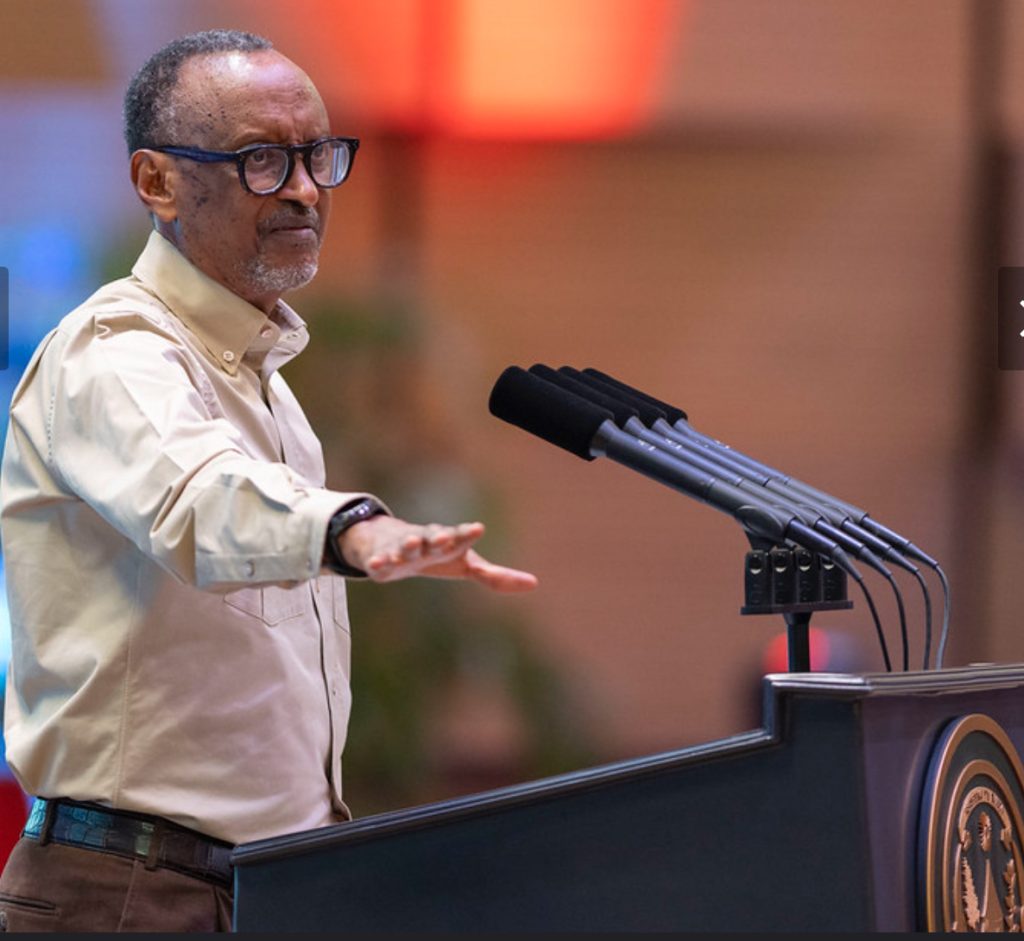
President Paul Kagame has accused Congolese forces and their allies of committing atrocities against civilians in the Minembwe area of eastern Democratic Republic of Congo, warning that communities are being attacked because of their identity while powerful international actors remain largely silent.
Addressing the RPF Political Bureau, Kagame said civilians had reportedly been struck indiscriminately by drones in populated areas, including markets and churches.
“People are being killed. Drones were firing at them indiscriminately in markets, in churches. Many people died,” Kagame said.
He called for an independent investigation, expressing confidence that the scale and circumstances of the violence would eventually be established.
“Hopefully, one day people will go there and investigate, and we will find the truth,” he said.
Kagame said what disturbed him most was the reaction Rwanda received when it raised concerns about the violence. According to him, an international interlocutor dismissed the matter as none of Rwanda’s business.
“Somebody says, ‘Don’t bring up that issue. It is none of your business,’” Kagame recalled.
He questioned why the killing of civilians should be treated as irrelevant, particularly when the victims appeared to be targeted because of who they were.
“But if it is not my concern, maybe it should be yours. So why are you not concerned?” he asked.
Kagame said such indifference evoked painful memories of the period before the 1994 Genocide against the Tutsi, when warnings about planned mass violence were ignored or dismissed.
“It is like those people being killed for their identity is none of your business,” he said. “It is like saying, ‘Shut up; we are going to kill them anyway.’”
The President placed the violence in Minembwe within the wider crisis that has troubled eastern Congo for decades.
He argued that the conflict did not originate in Rwanda and rejected attempts to reduce Congo’s internal political, citizenship and security problems to allegations against Kigali.
“This has not been our war. We did not cause it, and it did not originate from here by any means,” Kagame said.
He said the grievances behind the AFC/M23 rebellion are rooted inside Congo and include the treatment of Congolese communities whose citizenship and rights have repeatedly been questioned.
Kagame rejected suggestions that M23 fighters should be sent to Rwanda, insisting they are Congolese and that Rwanda cannot be held responsible for political and territorial arrangements dating back to the colonial period.
“I cannot be asked to answer for colonial-times problems. I was not there, and Rwanda is not responsible for that,” he said.
Kagame argued that the crisis became a direct concern for Rwanda because of the continued presence of the Democratic Forces for the Liberation of Rwanda, or FDLR, in eastern Congo.
He said the group had taken control of rural areas, established roadblocks and collected taxes from local communities. During a regional meeting in Nairobi, Kagame said he confronted a Congolese leader over the situation.
“What do you think FDLR is there doing, and why do you allow them to be there when we have asked to work with you to address that problem together and you have refused?” he recalled asking.
Kagame said Rwanda’s position had remained consistent: Kinshasa and the United Nations should dismantle the FDLR and prevent it from launching attacks against Rwanda.
“Either you sort it out, you Congo, or the UN that is employed there in its thousands,” he said. “You address that problem and stop them from invading our country, or we will sort it out ourselves eventually.”
He also referred to testimony delivered by a former senior FDLR commander, who reportedly described the militia’s operations across Congo and named Congolese officials and former colleagues who had been absorbed into state institutions and armed forces.
According to Kagame, the former commander possessed notebooks, photographs and other evidence documenting the group’s activities.
Kagame said the testimony also alleged cooperation between FDLR members and some United Nations peacekeepers in the gold, timber and agricultural sectors.
Despite such accounts, he said, the existence and influence of the FDLR continued to be denied or deliberately minimised.
“You will hear people say FDLR does not exist,” Kagame said. “Or if they say it, they say it so lightly that you should believe it does not matter.”
The President accused Congolese authorities of repeatedly resisting genuine efforts to resolve the conflict.
He said Rwanda had participated in negotiations in Luanda, Doha, Washington, Dar es Salaam and Nairobi, but claimed the underlying problem remained unchanged.
“There was one thing that was constant: Congo, or the leaders of Congo, did not want peace,” Kagame said. “They wanted to continue supporting FDLR against us.”
He said the Congolese government later received military support from other countries and regional forces, including the Southern African Development Community Mission in the DRC, known as SAMIDRC.
Kagame also alleged that new groups of foreign mercenaries had entered the conflict and were now working with Kinshasa.
He said the original diplomatic objective appeared to be the neutralisation of both the FDLR and M23, but that the focus had increasingly shifted towards defeating M23 while leaving the FDLR intact.
“This time, it has become finishing M23, not FDLR, because they are working with the same people and working with the government of Kinshasa,” Kagame said.
According to Kagame, any settlement that targets M23 without addressing the political grievances of Congolese communities and the security threat posed by the FDLR will fail to produce lasting peace.
“How do you think you can wish away all this without actually addressing some of the root causes?” he asked.
He said the crisis in eastern Congo could not be solved through military force, selective pressure or attempts to silence those raising concerns about atrocities.
For Kagame, the killings in Minembwe illustrate the central failure of the current approach: civilians remain exposed, identity-based violence is dismissed, and the armed groups at the centre of Rwanda’s security concerns continue to operate.
“Things keep getting worse and out of control every time,” he warned.