

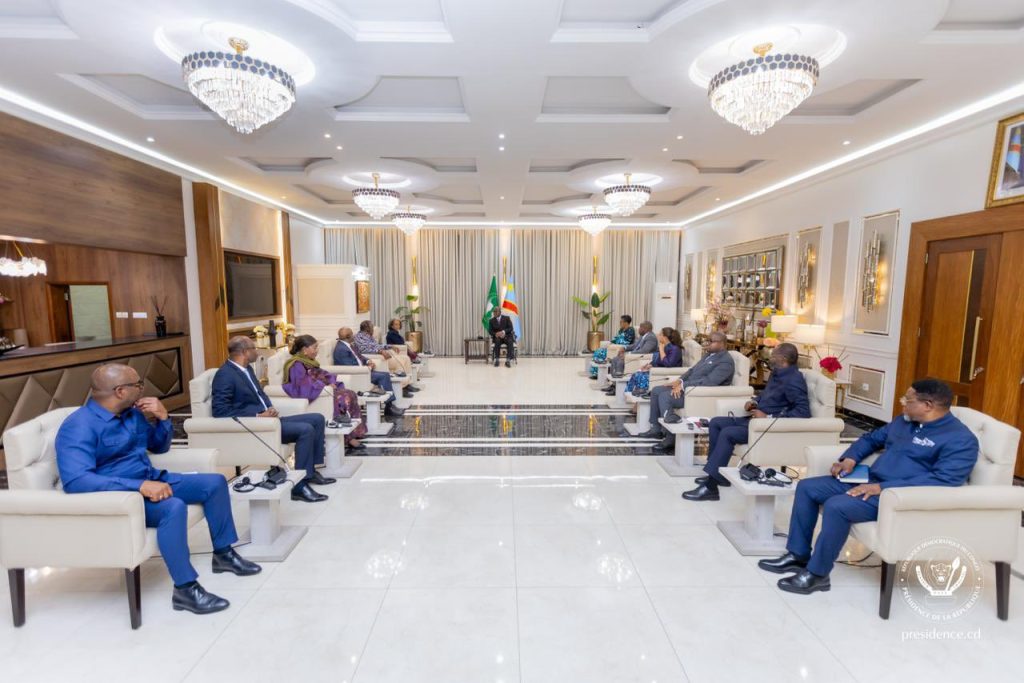
President Félix Tshisekedi has called for concrete, verifiable implementation of peace commitments in eastern Democratic Republic of Congo.
The appeal comes as fighting continues, drone and artillery attacks are reported, and rights groups document abuses by forces on different sides of the conflict.
Tshisekedi made the remarks on Friday in Kinshasa during a meeting with an African Union delegation comprising former presidents Sahle-Work Zewde, Uhuru Kenyatta, Catherine Samba-Panza and Mokgweetsi Masisi.
Prime Minister Judith Suminwa and sector ministers also attended. The meeting was part of a 72-hour consultation mission focused on the security crisis and the Washington and Doha peace processes.
The Washington agreement is between the DRC and Rwanda, while the Doha process involves Kinshasa and the AFC/M23.
Although a ceasefire verification mechanism was agreed under the Doha framework, its first field mission did not take place until August 24, when monitors visited Minembwe in South Kivu. Qatar called the visit a first practical step towards putting the mechanism into operation.
The fighting has continued during the diplomatic efforts. A conflict review published on October 7 reported that control of several villages in South Kivu shifted between government-aligned forces and M23 in early October.
In one example, government-aligned forces reportedly took Numbi, Shanje and nearby localities before M23 recaptured Numbi, Shanje and Kavumu on October 7. The review also reported that Wazalendo fighters set fire to dozens of houses and shops and looted livestock as they withdrew from Shanje.
Air and drone strikes have drawn particular scrutiny. ACLED recorded more than 60 air and drone strikes by the Congolese military in eastern DRC in 2026.
The figure does not establish that every strike hit civilians. However, after a March drone attack in Goma killed three people, including a French UNICEF aid worker, an ACLED analyst said several indicators pointed to likely FARDC involvement.
The Congolese government said it was investigating the attack.
Human Rights Watch documented eight reported drone strikes in South Kivu between January and March. Witnesses and relatives said two civilians, an 86-year-old man and a 14-year-old boy, were killed.
Residents also reported damage to homes, livestock and a community radio station. HRW could not confirm who carried out the strikes, but said the targets suggested the drones were controlled by the Congolese army or allied fighters.
Abuses have also been attributed to government-aligned armed groups. In June, Amnesty International said CMC-FDP, which it described as backed by the FARDC, had killed and tortured civilians in Rutshuru.
The group denied the allegations. A UN briefing to the Security Council separately reported 1,221 human rights violations and abuses across the country during its reporting period, affecting 2,968 people, including 392 women and 378 children.
The UN said the violations included conflict-related sexual violence by armed groups and members of the defence and security forces.
The humanitarian toll remains immense. On October 9, the UN Humanitarian Coordinator said six million people were internally displaced in the DRC. He also reported more than 353 incidents affecting humanitarian operations in 2026 and six humanitarian workers killed.
After consultations in Goma and Kigali, the AU panel called on the Congolese army and AFC/M23 to respect the ceasefire, cooperate with verification mechanisms and avoid actions that could undermine the peace process.
The panel’s challenge is to turn that appeal into compliance. Tshisekedi’s call for others to honour agreements also places scrutiny on whether Congolese forces and their allies will be held to the same standard.