

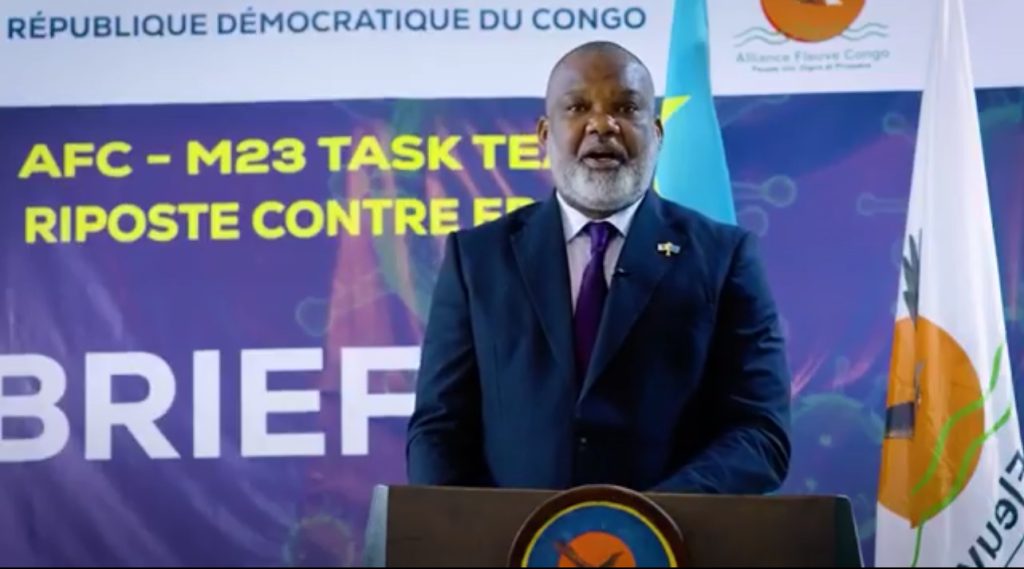
AFC/M23 Coordinator Corneille Nangaa has called for international cooperation in the fight against Ebola in eastern Democratic Republic of the Congo, urging humanitarian actors to prioritize public health over political divisions as fears grow over the spread of the deadly virus in North Kivu and Ituri provinces.
In a statement shared publicly, Nangaa expressed appreciation to international organizations, particularly the World Health Organization, for rapidly mobilizing support to contain the outbreak and respond to urgent medical needs in affected areas.
“Our gratitude goes to international partners such as WHO and others who have swiftly mobilized alongside us to address the most urgent needs,” Nangaa said.
He added that the AFC/M23 alliance remains open to what he described as “sincere, responsible, and constructive collaboration” aimed at protecting civilians and strengthening the Ebola response.
“The fight against Ebola must be a space for humanitarian convergence and not for division,” he stated.
The remarks come as the latest figures show the outbreak escalating rapidly across eastern Congo. According to the WHO, as of May 21, at least 746 suspected Ebola cases and 176 suspected deaths had been recorded in the DRC, while 85 confirmed cases and 10 confirmed deaths were reported across the DRC and Uganda.
Health authorities say the outbreak, linked to the rare Bundibugyo strain of Ebola, has spread across Ituri, North Kivu and South Kivu provinces.
The strain currently has no approved vaccine or specific treatment, raising fears among health officials and humanitarian agencies.
The WHO has now classified the national risk level in the DRC as “very high,” warning that insecurity, population displacement, weak surveillance systems, and growing public mistrust are severely complicating containment efforts.
The outbreak has already triggered unrest in affected communities. In Ituri province, angry residents stormed and burned parts of an Ebola treatment facility after authorities refused to release the body of a suspected Ebola victim for burial, highlighting deep mistrust toward health interventions and official restrictions surrounding funerals and burials.
International health agencies have intensified emergency operations as fears mount over cross-border transmission into neighboring countries including Rwanda and Uganda.
Uganda has already confirmed imported Ebola cases linked to travel from eastern Congo.
The current outbreak is the 17th Ebola epidemic recorded in the DRC since 1976.
Health experts warn that the combination of conflict, humanitarian crisis, weak healthcare infrastructure, and delayed detection could allow the virus to spread further if response efforts are not rapidly strengthened.